Powered by Blogger.
Guitar Classic
Classic Guitar
Guitar Bass

Tuesday, March 9, 2010

Goya Rangemaster vintage Italian-made guitar with split pickups

guitarz.blogspot.com:

Alan writes to say:
It's not only eBay where you find wacky guitars. Check out this page from the Washington DC USA branch of Craigslist.
Of course he's absolutely right. I tend to check eBay because it's much more international and I do like to think that I could bid on these items myself once in a while.

But never mind all that, this guitar - a Goya Rangemaster from 1968 - is a real beauty. I expect it is so named because of the range of tones obtainable from the split pickups allowing you to mix the sound of the top three strings in the neck pickup position with the bottom three strings in the bridge pickup position and vice versa. (There seem to be lots of these split pickup guitars coming out of the woodwork lately).

The design is reminiscent of the Gibson Barney Kessel with its twin Florentine cutaways. However, probably due to the location of the banks of switches, the f-holes seem to have gone south!

As with other Goyas, it is re-badged guitar for import into the US market. The Rangemaster series was made in Italy, which you may already have guessed from the general design with all those switches, and the manufacturer is believed to have been the Polverini Brothers, although this remains unconfirmed.

For more information there is a great site about Goya guitars at goyaguitars.tripod.com.

A great find!

G L Wilson

Guitarz - The Original Guitar Blog - now in its 9th year!

Ex-Nuno Washburn Mouradian prototype

guitarz.blogspot.com:

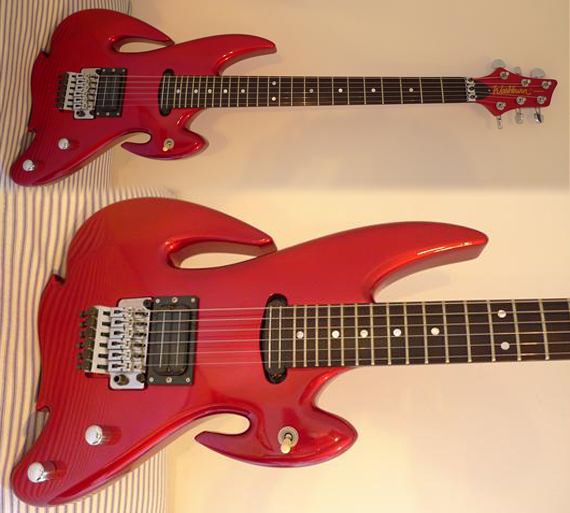
Yes, I appreciate that this Washburn Mouradian guitar is a rare "one-of-a-kind" prototype model.

I appreciate also that it belonged to Nuno Bettencourt and is the actual guitar that he played it with Extreme at the Freddie Mercury tribute concert in 1992.

Nevertheless... a $35,000 Buy It Now price on eBay?

You're having a laugh?

Thanks to Jono for bringing this guitar to our attention. As he says, "You gotta wonder where they pull out those prices from and more importantly, who the hell buys this stuff?"

I've got nothing against Mr Bettencourt, who is a fine guitarist, but I wouldn't have thought he was the kind of guy whose personal instruments commanded those kind of big bucks. That asking price is not quite in Hendrix/Beatles/Elvis territory, but it's close.

G L Wilson

Guitarz - The Original Guitar Blog - now in its 9th year!
Monday, March 8, 2010

Jerry Jones Danelectro Longhorn Baritone Doubleneck

danelectro longhorn doubleneck

Yes, this guitar is everything the title of this post says: a Danelectro model reissued by Jerry Jones Guitars (who started to build Danelectro models when the brand had disappeared for almost 3 decades - with the claim of actually upgrading them) in 1987, a longhorn guitar - one of the coolest design ever, and quite interesting in term of ergonomics (I'm a longhorn player myself) - and a doubleneck guitar with a baritone neck (only Danelectro and Gretsch do that if I'm not wrong), that is to me the sensible thing to have for a doubleneck guitar...

For those who never played a Danelectro, it's quite an minimalist experience when you're used to heavy body heavy gear guitars, and the lipstick pickups have an unique sound... This is an instrument I'd definitly play, if I could find it with a regular black finish and not this hideous 'copperburst' disaster...

Why, but why do they spoil guitars with these ugly finishes (this applies to several earlier posts too)?

bertram

NB: Please make sure you are reading this Guitarz post at guitarz.blogspot.com and not on a Scraper blog that copies posts without permission (and steals bandwidth) so as to profit from advertising. Please support original bloggers!

The SMASH guitar by K's JAPAN, built to be trashed and then recycled

guitarz.blogspot.com:
Regular Guitarz readers will remember my diatribe against smashing guitars on this post about Nine Inch Nails selling their old used - and sometimes abused - gear on eBay. The main thrust of my argument was that it is such a tired old cliché and surely after all these years bands can come up something more original by way of on-stage spectacle.

However, it seems a few lines of text on a guitar blog is not going to change the world, and such destruction in the name of music is not going to go away. As one commenter noted, each new generation finds it thrilling and exciting and they don't care less about what Pete Townshend got up to in prehistoric times.

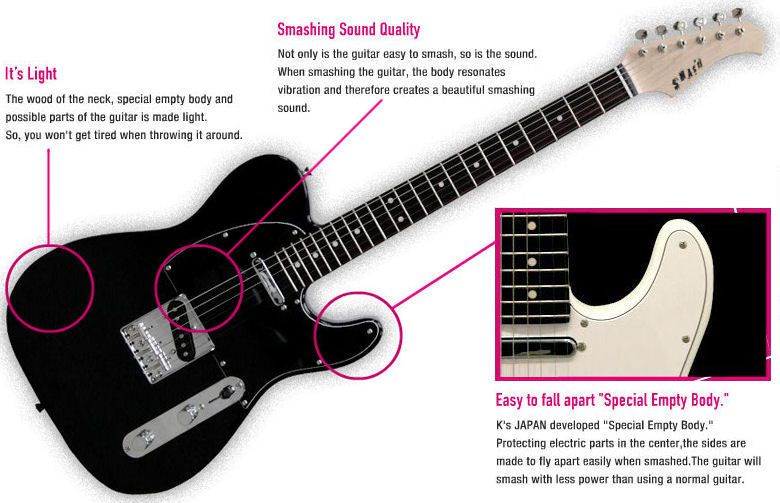
And now from Japan (where else?) comes a range of guitars that are actually designed to be destroyed. The SMASH guitar presented by K's Japan is priced at 5000 Yen (less than $60) and whilst it resembles a Fender guitar, it has a lightweight hollowed-out body that should smash quite easily and dramatically.

Once you've smashed your guitar and amazed and wowed your audience with your shocking, if unoriginal, act of destruction, you have the option of returning the resultant debris to the manufacturer who will use all salvagable parts to make new guitars and donate them to orphanages in the Philippines. This is the recycling part of the equation. Alternatively K's JAPAN offer a custom re-building option so you can do it all again. Unless this re-build is significantly less than the original 5000 Yen purchase price, it might just be easier to buy a new one.

Other options include a SMASH amplifier to smash your SMASH guitar against (I expect it falls to pieces quite easily and spectacularly), a "pick bomb" (guitar picks fly out of the guitar in all directions when it is smashed), and a SMASH Visualizer chip embedded into the guitar "to visually show the movement and collision of the guitar on to [a] screen".

Potential smashers should be aware that they need to sign a liability form before being allowed to purchase this product, and should be aware of the small print that says:
"This product is conceptual based on rock spirit. It is not created to suggest act of violence. K's Japan will not be responsible for any kind of damage it may cause when using Smash at your own risk."
Thanks to Pelle for bringing this interesting product to my attention (via crunchgear.com).

G L Wilson

NB: Please make sure you are reading this Guitarz post at guitarz.blogspot.com and not on a Scraper blog that copies posts without permission (and steals bandwidth) so as to profit from advertising. Please support original bloggers!

Sunday, March 7, 2010

Two become one: Tiago's modular doubleneck

guitarz.blogspot.com:
Doublenecks always look impressive on stage and are a sure temptation to any guitarist afflicted with GAS (Guitar Aquisition Syndrome), but in use they can be quite cumbersome and unwieldy.

If you've got to have a doubleneck the best option would be to have a modular instrument that can be split into two individual single-necked guitars when desired. That way you have two guitars for the studio and a doubleneck for live performances.

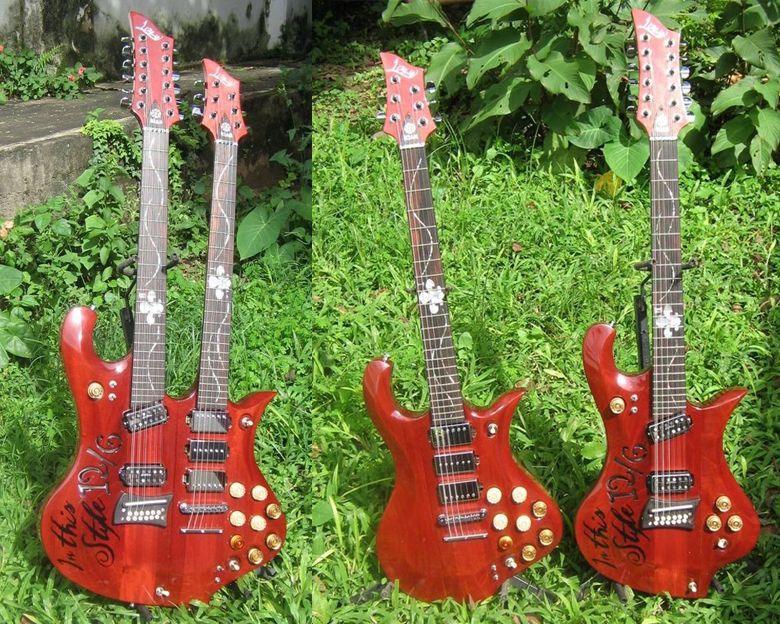
The guitar(s) pictured here belong(s) to Guitarz reader Tiago Sarmento from Brazil. Here's what he has to say about it/them [note: a modular doubleneck plays merry havoc with semantics - is it a single object or two?]... Anyway:
Mahogany body with two (now you can help me in english terms) ipê-tobacco stringers. Is that the right term, with those stripes on the back with different woods? Anyway, ipê is a national tree from Brazil, and it adds sort of a higher vibrations to compensate the dense mahogany body. The neck is brazilian rosewood.

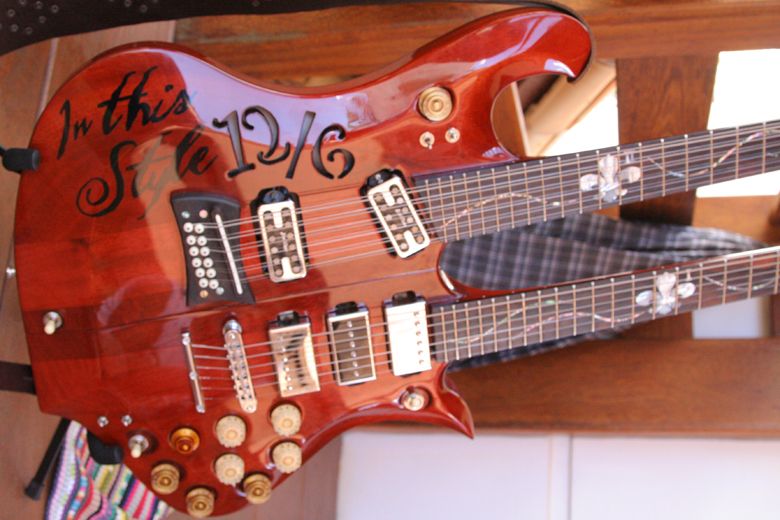
The 12 string part has a "12/6" F-hole. Is that after the Mad Hatter sign on his top hat, since I'm a big fan of Alice in Wonderland book. In the book, the hat says "10/6", but I added a "poetic license" there and put the 12 instead. Quite obviously why. The "In this style" adhesive - was supposed to be a pirograph - is complementary to the tag on Hatter's hat.

The inlay is slightly different from the 6 strings part, and has tha Fleur-de-Lis and a roman numeral "II" in mother-of-pearl and the branches in abalone. The pickups are a custom made from Brazil called Stelfner and they are built after the burstbuckers. It has a piezo pick up. The mini toggles are on for the piezzo (position 1= only piezzo; 2= piezzo plus electric and 3= only electric). The f-hole has a blue led light inside, and looks quite psychedelic in the dark. The second mini-toggle splits the pick ups into single.

The 6 string is quite the same, but when they're together, the lower part controls all the electronics. So it has 9 knobs. Each different so it facilitates the know which is which. The leds now are blue and likewise the 12, is on the top of each knob and on the scale, side-by-side with those white dots. The pick ups here are all gibson: 490t, p-94 and busrtbucker II. Mini toggles works the same way.

Each, of course, has its complementary parts. The luthier signs as KIAN GUITARS and these is my personal brand, Lizzie. In the back of the headstock there's a drawing. 12 = a mad hatter caricature and the 6 of mine, in a artistic design similar to my project's logo.
I've not edited the above because I'd prefer to leave it in Tiago's voice, as it were. However, I think it's all quite clear what he's talking about, and I'd like to thank him for sharing this with us.

Keep those interesting pictures and stories of your guitars coming in, guys!

G L Wilson

NB: Please make sure you are reading this Guitarz post at guitarz.blogspot.com and not on a Scraper blog that copies posts without permission (and steals bandwidth) so as to profit from advertising. Please support original bloggers!

Saturday, March 6, 2010

Wilkes "The Answer"

guitarz.blogspot.com:

Bertram was recently asking about pickup placement and nodal points. Well, with a guitar equipped with sliding pickups such as this Wilkes "The Answer" you could experiment to your heart's content.

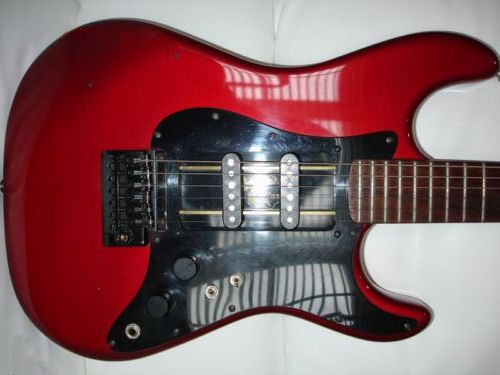
It's a very clever system. The two coils can be used independently as single coil pickups or together in humbucking mode. And, of course, you can position them just where you want.

These guitars date back to the 1980s and were made in the UK. Wilkes were keen innovators and other intriguing instruments included a fretless bass that incorporated metal slap plates at the top end of the neck and so could facilitate 80s-style slapping and popping on a fretless. (Personally, I'm trying to forget all that scary slapping and popping stuff. I never did understand the appeal of that racket.)

Wilkes Guitars, built by Doug Wilkes, are still in operation and guitars fitted with "The Answer" pickup system are still being produced.

G L Wilson

NB: Please make sure you are reading this Guitarz post at guitarz.blogspot.com and not on a Scraper blog that copies posts without permission (and steals bandwidth) so as to profit from advertising. Please support original bloggers!

Friday, March 5, 2010

Flyte-inspired lap steel, a.k.a. the KKK Hawaiian!

guitarz.blogspot.com:
Lately I've been looking through some of the lap steels and Hawaiian guitars being sold on eBay, becuase, let me tell you, there are some really wacky designs in this whole sub-group of our favourite instrument.

Look at this one. There are currently two sellers on eBay.co.uk selling a guitar like this (here and here). Both are using the same photos and have copied the same text from somewhere which very mysteriously claims that:
This guitar is made by an "official" overseas manufacturer for one of the biggest name-brand guitar companies (which I can not name here, per eBay's ebay rules).
I'm not aware of anything in the eBay rules that says you can't name the manufacturer of the goods you are selling, but I get the impression that this isn't really what the seller means. It's more likely a question of copyright infringement.

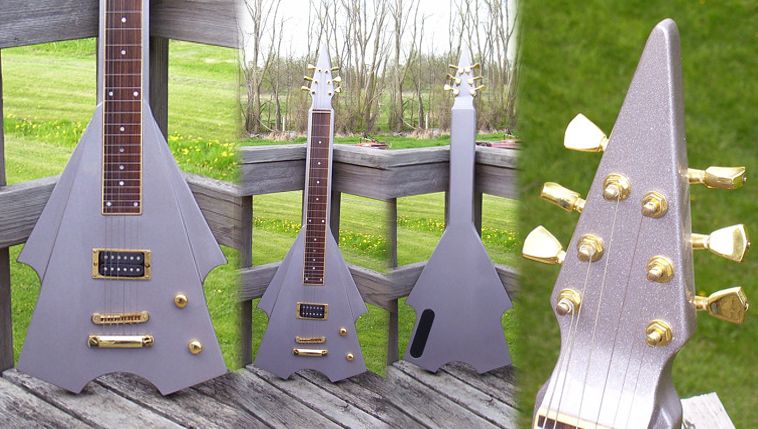
This lap steel guitar is obviously based on the now legendary Burns Flyte guitar, which is one of my personal all-time favourite designs. However, unlike the real deal, it does not look sculpted, elegant and classy. It looks flat and two-dimensional as if it had been cut out of a sheet of MDF (although apparently it's the ever-popular basswood) and the pointed headstock looks like it could be lethal.

Even more disturbingly, standing up like that in the photo, it resembles the silhouette of a member of the Ku Klux Klan.

Please don't tell me that this is genuine Burns products (if it was, why the secrecy over the name of the manufacturer?) because I'd hate to think they'd lower their standards so very much as to produce this abomination.

G L Wilson

NB: Please make sure you are reading this Guitarz post at guitarz.blogspot.com and not on a Scraper blog that copies posts without permission (and steals bandwidth) so as to profit from advertising. Please support original bloggers!