guitarz.blogspot.com:
The Misa digital guitar is an Aussie MIDI synth-controller and which - at first glance - reminds me of a more professional Yamaha EZ-EG combined with a KAOSS-pad type controller, although to say that is probably to do it a dis-service.
It is powered by the Linux operating system and software is open-source, allowing individuals the flexibility to modify it to their own requirements and to share their innovations with others. Sounds a bit too much like rocket science to me, I'm afraid.
Read all about it at: misadigital.com
Thanks to Dave Brown for submitting this to Guitarz.
G L Wilson
NB: There are a lot of blogs STEALING content and bandwidth. If you read this anywhere else but on guitarz.blogspot.com then you are reading a blog that STEALS content. Please support original bloggers!
|
|
|
|
|---|
Showing posts with label MIDI guitar. Show all posts
Showing posts with label MIDI guitar. Show all posts
Thursday, January 21, 2010

Sunday, July 5, 2009
Casio MG-510 / MG-500 MIDI guitars

Why is it almost impossible to have a good picture of a guitar from the 80s?
Anyway, here are the Casio MIDI guitars MG-510 (the strat clone) and MG-500 (the cool bizarre shaped one).
So no, Casio didn't just issue cheap watches, pocket calculators and toy keyboards for minimalist German electro-punk bands, they also produced some very interesting MIDI guitars - at least they provided the concept and the electronics and had famous guitar manufacturer FujiGen Gakki make the guitar parts.
It seems that these Casios where some of the best MIDI guitars of their time, a. o. since they completely integrated the MIDI system and the controls - no other did... You can get more info here.
And I think that the design of the MG-500 is one of the best of its MIDI 80s kind.
Tuesday, April 14, 2009
Stepp DGX MIDI guitar controller
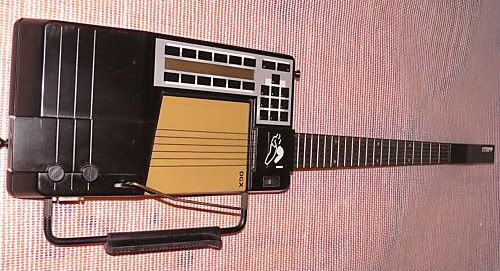 Looking like someone has taken Rolf Harris's Stylophone and stuck a guitar neck on in, the Stepp DGX MIDI guitar controller - whilst still very expensive - was a cheaper alternative to the very wacky-looking Synthaxe. Unlike the Synthaxe, this particular synthesiser controller was much more guitarist friendly in that the strings for the playing and the fretting hands were both on the same plane and pointing in the same direction, and the frets were laid out normally with none of this equal spacing nonsense.
It was never a big success, and after appearing in the hands of Maurice Gibb of The Bee Gees and an appearance in the movie Vice Versa (starring Judge Reinhold and Fred Savage as a father and son who swap places) where it was inexplicably overdubbed with the sound of a real electric guitar, it sank without trace. Let's face it, it was no great loss.
Monday, September 15, 2008
Yamaha EZ-EG digital guitar
 Here's something that I've been playing about with over this last week. Now I've seen these "guitars" before and had always written them off as being toy-like. However, having read a few reviews and followed some discussions on forums, I decided that I'd like to try one out. Although it was designed as a basic learning instrument (the idea being that the learner can play along to songs with a backing track whilst being guided by chord shapes that light up on the "fretboard"), the fact that it is MIDI-equipped makes it really quite interesting.
I found a seller from Japan on eBay who seemed to be shifting a fair few of these, and the price wasn't too prohibitive, so I thought I'd give it a whirl. Last Monday I arrived home to find that it had been delivered - and all without having to pay the expected custom charges (although perhaps I should keep quiet about that).
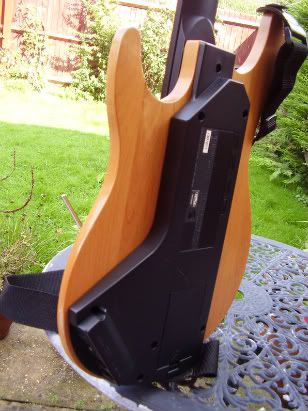
Getting it out of the box my first impression was of how toy-like it looked. The wooden body is a nice touch, but much of the rest of it is plasticky and flimsy-looking. The wooden portion of the body is only a thin slice sandwiched between two layers of plastic housing parts for the electronics. I mean, look at the back of this instrument, it's hardly neat is it? It would have been so much nicer if all the electronics could have been housed inside a wooden body. It needn't cost that much to produce. Bear in mind that Yamaha also produce the cheap and cheerful (and excellent value-for-money) Pacifica 112 guitars which have solid wood bodies.
The plastic neck also is very insubstantial. When playing the "guitar", I was aware that I was bending the neck when playing certain chords. Again I wonder if the back of the neck couldn't have been made from wood.
Another gripe is that on my model the tremolo arm seems to be totally knackered. Unfortunately this guitar was sold as seen, and even if it wasn't any return postage to Japan would make this a much more expensive experiment.
On plugging in and turning it on I soon found out that the internal speaker beneath the "strings" on the body is absolutely rubbish. Every sound I tried selecting was distorted and quite unlistenable. Oh dear, so far NOT so good.
Next I plugged in headphones. Now, that's better!
Now this "guitar" doesn't actually have any strings as such. It has buttons for each of the fret positions on six strings up to the twelth fret, and for the right hand it has six plastic bars which can be picked, plucked or strummed. I was surprised at how quickly I was able to find my way around using this system. In its favour, it does feel like you are playing a real stringed guitar. The fretboard buttons are shaped as if they are small sections of string, and the right hand "strings" are actually quite responsive. Keying the left-hand string-buttons will start up the relevant note(s) but quietly as if hammering on with the left hand on a real guitar. You need to strike the right hand "strings" to get any real attack to a note.
Obviously with the string-buttons you can't perform string bends so no chance of any expression there, but you are allowed quite a lot of expression with the right hand as those bars seem very responsive. They are certainly responsive in terms of volume, in how hard or softly you play the strings.
I suppose the other way of injecting a bit of expression would be through use of the whammy bar, but that's a no-no on this particular example.
There are twenty on-board sounds. A classical guitar, steel-strung guitar, twelve string, several basses, banjo, etc. Some sounds are better than others (the banjo's quite good), and the bass sounds are better when you drop the whole instrument down an octave using the tuning function. The 12-string sound raised an octave gives quite a nice mandolin sound.
 Did I mention that the string-buttons on the "fretboard" light up as you play them?. Although this was conceived as a learning aid and might seem a little cheesy, it's still quite useful because it highlights where you are playing sloppy chords, perhaps where one finger is straying slightly onto a string where it shouldn't, which I'm sure I do quite a lot. So, it discourages sloppy playing, which is surely a good thing.
So things are getting more interesting, but it's still limited in what it can do.
Next I dug out my old Yamaha QY-20 sequencer and connected the guitar with MIDI cables. Now the cables were quite short at only two metres so I made a mental note not to go walkabout while playing. (I doubt I'd ever want to play this in a performance, so no worries about running about the stage and not having a long enoguh MIDI cable).
I used to use the QY20 quite a few years ago when recording songs. I'd spend ages programming it, but rarely entered any tracks in real time as I'm not too familiar with a keyboard layout and also the keyboard on this thing is tiny and made of rubber. How great would it be to be able to use a controller laid out like a guitar fretboard, something that I'm familiar with.
The guitar hadn't come with a manual so there ensued a session of trial and error trying to get the guitar to communicate with the QY-20. For ages it seemed that nothing was working, then I realised that I had a synth sound from the QY-20 on the high E-string.
With just one string working I tried out a few QY-20 sounds. Some worked better than others. Not everything sounds great with the kind of attack you get from plucked strings. I particularly liked some of the more tuned percussion sounds such as vibes and xylophone.
It took me a while to work out how to get all the other strings working. The QY-20 is an 8-track sequencer. What the MIDI was doing was assigning one "string" of the guitar to each of the first six channels of the QY-20. I found it somewhat tedious having to dial in the same sound to each of the six channels just to try out a synth sound across the whole guitar, but I soon realised that this system had its advantages too. For example, I could assign different synth sounds to different strings. This sounded quite interesting with sax sounds where I could put a baritone sax sound on the low E and A, tenor sax on D and G, and alto sax on B and high E.
Another trick was that I was able to pan each string to a different position in the stereo spectrum. Neat!
Now I was beginning to get ideas... But, these are going to have to wait for now as I want to experiment some more. I think the real test will be to record a song using this instrument.
Stay tuned...
Wednesday, August 13, 2008
Casio Synth Guitars


Casio synth guitar
Ah yes, the constant quest for the sound of tomorrow - the synth guitar. There have been many advances since these Casio's were produced - though I know Bob Weir of The Grateful Dead (Best Band In The World) used a Casio MG510 for a while. I've never played a synth guitar, but of course with midi pickups and everything it is much easier these days to get a realistic and responsive system - Garcia and Phil Lesh of the Dead also used them - I remember seeing The Dead at Wembley and Garcia's trumpet playing was stunning. This one is here, with the added advantage that you can type in the numbers "07734", turn it upside down and say "hello"!

This is the one that Bob Weir played for a while - the MG510
Subscribe to:
Posts (Atom)