Powered by Blogger.
Guitar Classic
Classic Guitar
Guitar Bass
Showing posts with label British guitars. Show all posts

Sunday, April 3, 2011

Watkins Rapier 33 from 1961

guitarz.blogspot.com:
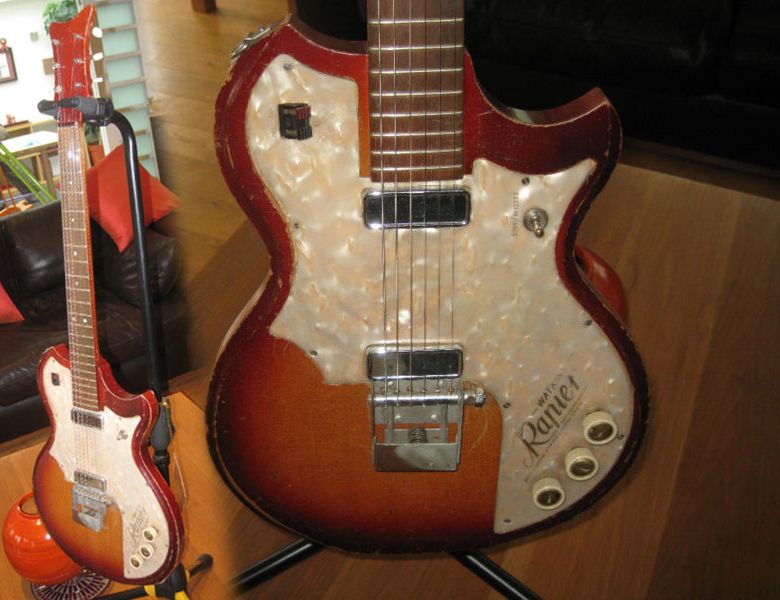
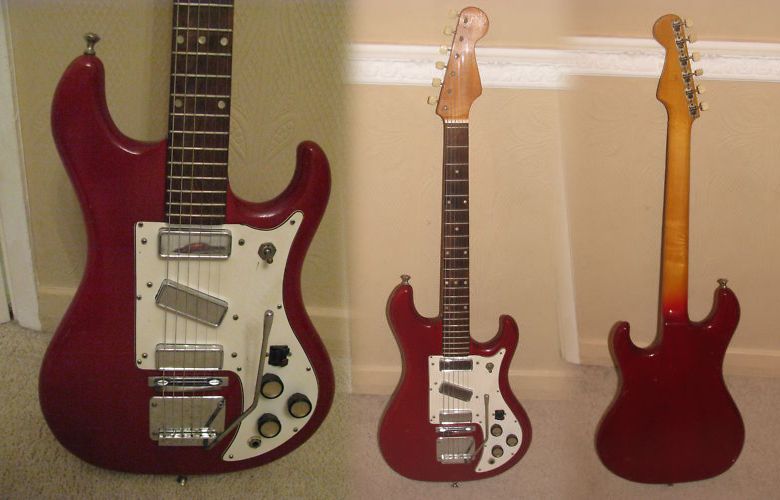
Further to the previous post, here is one of the latter, more commonly-known, Strat-inspired design of Watkins Rapier, although this one from 1961 is still quite an early model. If you compare and contrast with the Rapier in the previous post you'll notice that they are not really the same guitar at all, they just share a common name. This one is a Watkins Rapier 33 - the 33 denoting three pickups.

G L Wilson

Edit: Sold for £210.

© 2011, Guitarz - The Original Guitar Blog - now in its 10th year!

Watkins Rapier from 1958 - the original model

guitarz.blogspot.com:
Compare this early 1958 Watkins Rapier to the later models and it should become apparent how revolutionary the Stratocaster design must have been at the time, for manufacturers such as Watkins to borrow from its curves in their later designs. This early slab-bodied model Rapier was only made from 1958-1959. Some later examples borrowed the Strat-style headstock shape before the redesign to make the whole guitar's outline more Stratty.

For more about Watkins and associated brands WEM and Wilson, I must direct you to the fantastic Watkins Guitar World website, essential reading for anyone interested in the history of British guitars.

G L Wilson

© 2011, Guitarz - The Original Guitar Blog - now in its 10th year!

Sunday, March 20, 2011

Electric harp guitar, handmade in Hastings, UK

guitarz.blogspot.com:
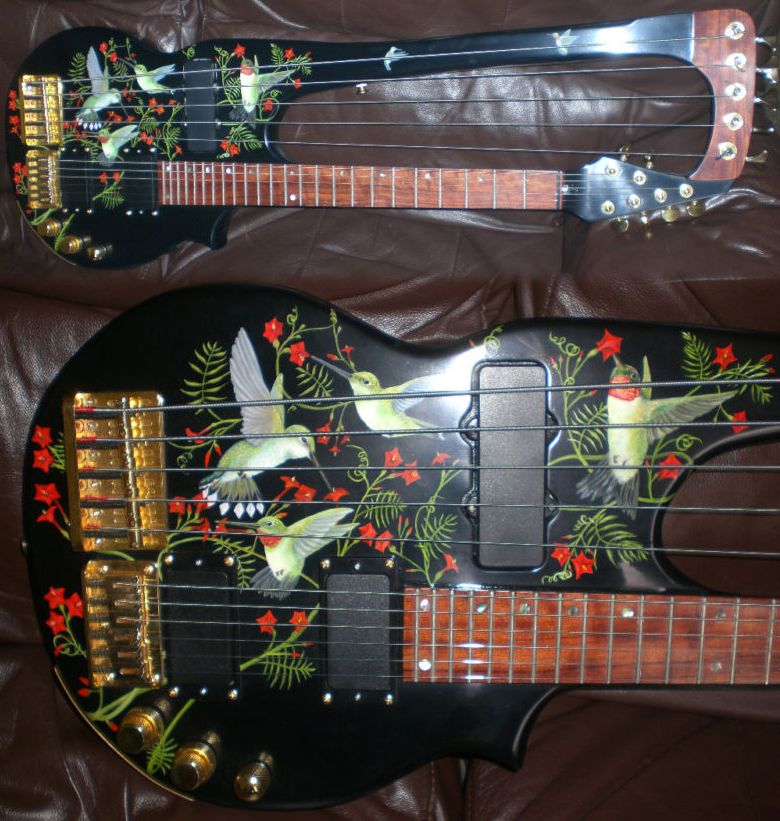
Now here's something a little bit different, an electric harp guitar with a six-string guitar neck plus five sub-bass strings. I'll copy the specs from the listing:
Hand carved from a single piece of Obeche with Bubinga fingerboard and headstock veneer.

Guitar scale length-25.5". Zero radius(flat)fingerboard. Medium frets.

Grover guitar tuners.

Kent Armstrong PAF and PAF+ guitar pickups.

Humbucking Bass pickup.

Stacked volume and tone controls with Sprague orange drop capacitors.

Separate jack outputs. Seperate bass and guitar amps are recommended for the best sound.

Handpainted Hummingbird scene by american artist Cynthia McGinnis.

Gold hardware.

Custom pickup wiring with 5way rotary switch for humbucking/single coil selection.
G L Wilson

Guitarz - The Original Guitar Blog - now in its 10th year!

Tuesday, March 8, 2011

1960s Fenton Weill Twistmaster (we think)

guitarz.blogspot.com:

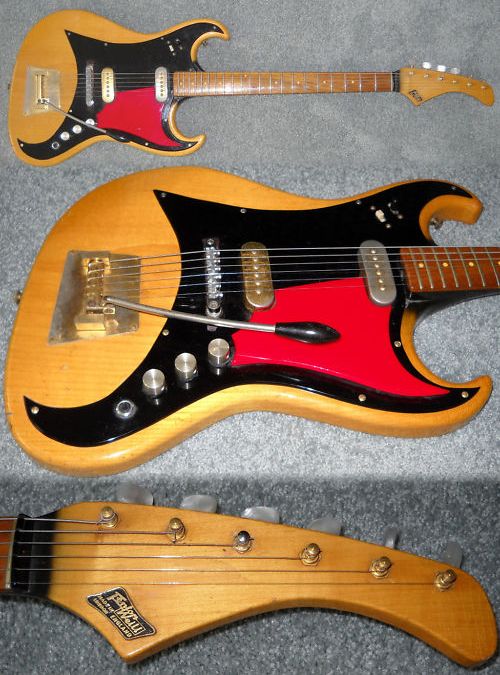
There's something awfully "homemade" looking about these vintage British guitars from Fenton Weill. This model, which the seller suspects is a Fenton Weill Twistmaster (I don't know enough about the brand to contradict that claim) is typical in that it looks as if it was assembled in someone's garden shed. Note the interesting double pickguard. Another odd feature is that although the guitar is finished in blonde, the back of the neck is inexplicably picked out in black.

There must surely have been some connection with Vox and/or Jennings Musical Industries of Dartford, Kent. The headstock is exactly the same as that I had on my old Vox Clubman II. The Fenton Weill neck looks to be glued in, by the way; it's not a simple bolt-on job.

G L Wilson

Guitarz - The Original Guitar Blog - now in its 10th year!

Wednesday, March 2, 2011

1960s Vox Clubman bass

guitarz.blogspot.com:
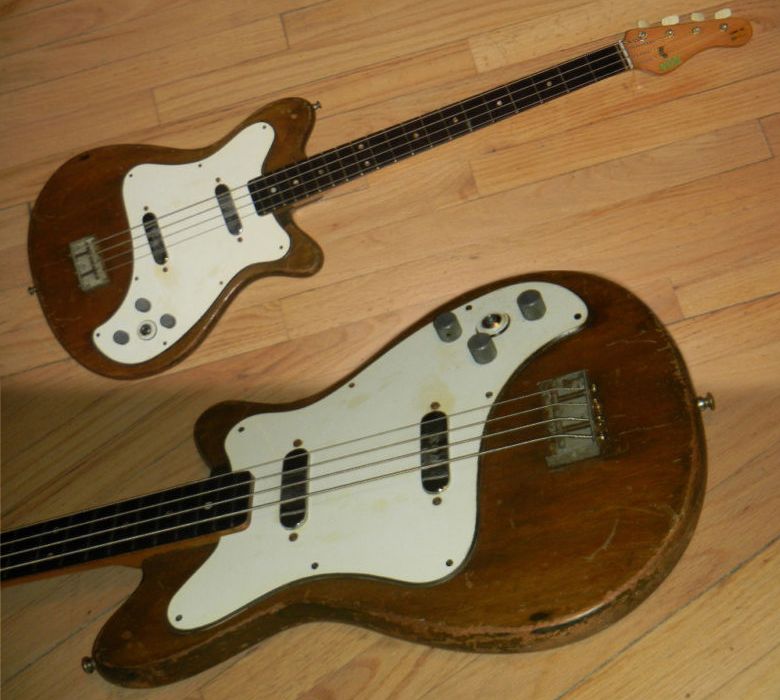
I think in the early days Vox must have been rather slapdash about the names they applied to their guitars, as I had previously thought that the above-pictured bass was the Vox Bassmaster and not the Vox Clubman Bass which is the name that appears on the headstock on this example currently for sale on eBay. To confuse things even more, the name Vox Bassmaster also appeared on a completely different design of bass.

These early Voxes, made in Dartford, Kent, in the UK, were essentially student model guitars with a very thin plywood body. It looks as if the original finish (most likely red) was removed from this example a long time ago. Note also the jack socket, which would have been added later. Early Voxes such as this had a TV-like co-axial socket, as did the Vox Clubman II guitar I used to own (before I upgraded it).

Despite their student status, these basses are known for their distinctive sound and playability. Personally, because of their cheap construction, I wouldn't have thought they were eminently gig-worthy but perhaps to get that certain sound in the studio they would be desireable.

G L Wilson

Guitarz - The Original Guitar Blog - now in its 10th year!

Friday, February 25, 2011

Another mystery guitar needs identifying

guitarz.blogspot.com:
Here's an email from Jack:
Hi Gavin

I've been an avid follower of your blog for a few years now and I have always admired your ability to identify random guitars!

Attached is a pic I took at a gig in Bristol earlier this week. It was the support band for Morning Parade and the guitar was seriously unusual.

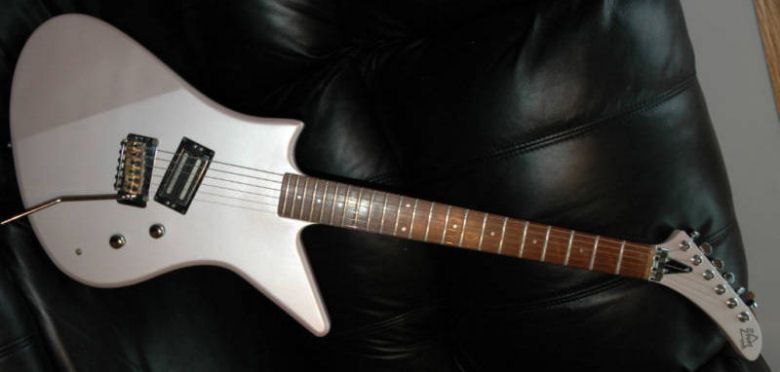
Don't know if its that obvious from my (very bad) pic but the guitar had slanted lipstick pickups on humbucker sized plates, an old varitone switch on it and what looked like a small pushbutton switch, in addition to a pickup selector and volume. Tune-o-matic and then through body stringing. Unusual finish too. Not sure if it was modern or vintage... not a lot of help I know! I couldn't read what it said on the headstock, annoyingly!

I think the support band was called Jet something but I didn't quite catch it. Probably not a lot of use but you never know, someone may know what it was. It sounded awesome, by the way!

Thanks for any help you can give.

Jack Floyd
Thanks for the praise, but I don't think I'm going to come up trumps in this case. This is a design that I feel I should know and am sure I have seen somewhere before, but unfortunately I cannot put a name to it. If any of our readers can help, please tell us what you know via the comments.

G L Wilson

EDIT: It's a Roberts Iris and the band are called JetKing. Thanks to Bid Red X for that info!

Guitarz - The Original Guitar Blog - now in its 10th year!

Wednesday, December 22, 2010

Gordon Smith electric mandolin

guitarz.blogspot.com:
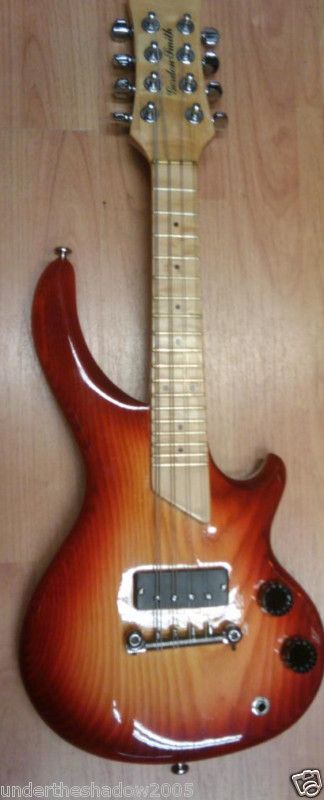
Here's another take on the electric mandolin, which couldn't be more different than the Gibson Futura mandolin prototype we looked at recently. This is a Gordon Smith electric mandolin, made in Britain, and is - I believe - a one-off build. It is an original design - unusual given Gordon Smith's usual Gibson influences, and features a very compact body (unlike the long stretched-out body of the Gibson) with a lengthy upper horn which no doubt would let it hang on a strap much more nicely than the Gibson. It also has the traditional eight strings arranged in four paired courses that we expect to see on a mandolin and so would appeal more to purists.

G L Wilson

Guitarz - The Original Guitar Blog - now in its 9th year!

Tuesday, December 7, 2010

Hayman 2020 with f-holes

guitarz.blogspot.com:
This is a Hayman 2020 guitar, a rare model with f-holes. I'm guessing from its bolt-on neck design it's more of a "thinline" rather than a semi-acoustic, although it's hard to say from the photographs alone.

The guitar was designed by Jim Burns and would have been produced in the UK in the early 1970s before the distribution deal with Dallas Arbiter finished and the Shergold brandname replaced Hayman.

Note the glass(?) "H" logo inset into the headstock. This is what was missing from the hole in the headstock of the left-handed Hayman 4040 bass we looked at in October.

G L Wilson

Guitarz - The Original Guitar Blog - now in its 9th year!

Wednesday, December 1, 2010

Electric 12ers #3: Baldwin Double Six electric XII

guitarz.blogspot.com:
Here's our third electric 12-string of the day. Jaimie says:
I guess Baldwins aren’t that crazy, but the green burst always gives them a slightly off-kilter look to me...
Of course, most of us would recognize this Baldwin Double Six electric XII in greenburst as being a Burns guitar, the Baldwin name having been applied following the sale of Burns London Ltd to the Baldwin Piano and Organ Company of Cincinnati in 1965. This particular example is from 1966-67.
Baldwin/Burns guitars lasted until 1970 when the Baldwin company terminated the range.

In the 1970s, after making a prototype for Hayman guitars, Jim Burns returned to making guitars in his own name using the trade names Burns UK and Jim Burns Actualizers Ltd. Burns UK produced the Flyte guitar - a favourite of ours here at Guitarz - and Jim Burns Actualizers Ltd were responsible for such models as the Steer and the Scorpion.

G L Wilson

Guitarz - The Original Guitar Blog - now in its 9th year!

Monday, November 8, 2010

Egypt Karnac Osirus from 1986

guitarz.blogspot.com:
OK, so it may be an 80s guitar, but this Egypt Karnac Osirus is a quality UK-made instrument and certainly not one that everyone else is going to be playing.

Quite how this model differs from the Egypt Karnac Luxor we previously looked at this time last year, I don't know, because they look identical to me. In fact, I suspect this may even be the exact same guitar. Perhaps the seller got the name wrong. Note that there is some confusion in the eBay listing, as we are told that Egypt Guitars were made in Glasgow, Scotland, but the heading says "Made in Ireland". The seller also claim that this is a prototype, serial # A004, and that only five examples of this model were made, and only one in this metallic lilac. If that's all true, it must be the same guitar.

Anyway, the auction finishes tomorrow night, so if an unusual Scottish-built metallic lilac 80s guitar is your thing, then snap it up!

G L Wilson

Guitarz - The Original Guitar Blog - now in its 9th year!

Wednesday, November 3, 2010

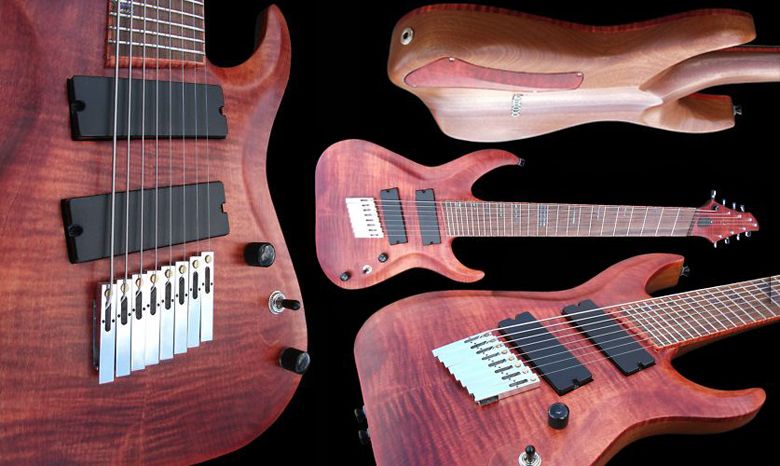
Crimson 8-string fanned-fret guitar

guitarz.blogspot.com:
I've been meaning to write about Crimson Guitars for ever. The guitars are painstakingly handcrafted by Ben Crowe and his trusty assistant Igor, and if you've ever had any interest in the construction procress then I recommend you follow the Crimson Guitars workshop diary on the website or alternatively on Facebook as Ben seemingly documents every step of the build for each guitar. They also produce their own hardware including tremolos, headless tuning systems, control knobs, bridges, etc, whilst pickups are often by Wizard, but of course they can be whatever the customer requires.

Past instruments have included those made from exquisite tonewoods with highly controured ergonomic bodies, touch style instruments, carved perspex guitars and basses, and clients include (appropriately enough) King Crimson's Robert Fripp and Charlie Jones, bassist with Robert Plant, Goldfrapp and Siouxsie Sioux.

This particular instrument is a fanned-fret multi-scale 8-string guitar which is suitable for touch-style playing. Crimson guitars are bespoke instruments built specifically to a customer's requirements, but they do produce the occasional stock instrument. I'm sure Ben won't mind me saying that this guitar, now being offered on eBay, only became available as a stock instrument because the customer changed his mind and decided he didn't like the slanted pickups. Unperterbed, Ben began the whole process again and built a second 8-string fan-fretted instrument for the customer. I have to say, the original that we see here with the slanted pickups looks much much better, but if the customer wants straight-aligned pickups that's what he gets!

If I ever come into money, my dream is to commision a Crimson guitar. I think they are so fantastic, I included two in the "500 Guitars" book.

G L Wilson

Guitarz - The Original Guitar Blog - now in its 9th year!

Tuesday, October 12, 2010

Hayman 4040 bass from 1973

guitarz.blogspot.com:
Here's another one for the lefties. It's a Hayman 4040 bass, built in London by Jack Golder and Norman Houlder of Shergold Woodcrafts Limited (established 1967). The Hayman brand name was applied to instruments distributed by Dallas Arbiter until termination of the contract in 1975. From 1975 to 1982 their guitars and basses appeared under their own Shergold brand.

G L Wilson

Guitarz - The Original Guitar Blog - now in its 9th year!

Tuesday, July 13, 2010

Gorgeous guitars from The Creamery

guitarz.blogspot.com:

I've been meaning to feature The Creamery on this blog just about all year, but was waiting for the website to go live, which I believe it did last month... but then, I got side-tracked as I so easily do these days!

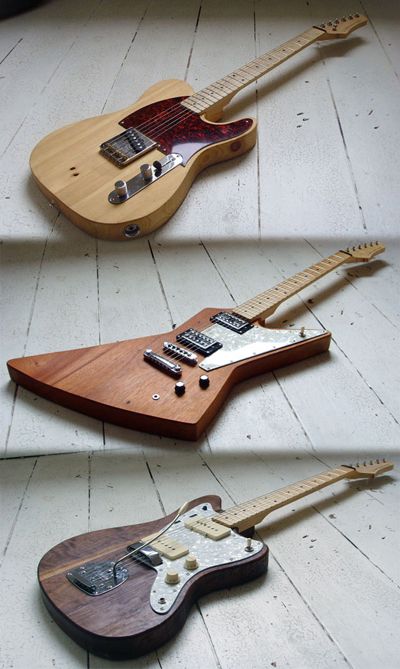
The Creamery are based in Manchester in the UK, and is the operation of Jaime Campbell who builds one-off custom guitars of the bolt-on neck, slab-bodied variety. Naturally this means Telecasters and Esquires as you might expect, but also some other body shapes too including Explorer (The Alleyway) and, my own favourite, a slab-bodied Jazzmaster (This Year's Model) inspired by Elvis Costello's guitar.

Jaime likes to use recycled woods and has posted on Facebook and Twitter about raiding skips to claim a piece of timber that someone else has just thrown away. The Fenchpost (pictured top left) for example, is an Esquire-type guitar with a body built out of an old pine fence post and which still has the nail holes proudly on display as a feature. I think it looks fantastic.

Another Tele-type has a body built from a butcher's block (The Butcher's Block) which not only gives it a unique appearance but is common sense, making use of a quality timber product which is quite frankly wasted on a mere chopping board.

I should also mention that Jaime also handwinds his own The Creamery brand scatterwound pickups, which are available to buy on their own without a guitar attached.

I can't wait to see what's next for The Creamery. I believe a Prince-style Telecaster is in the works.

G L Wilson

Guitarz - The Original Guitar Blog - now in its 9th year!

Wednesday, June 23, 2010

Greg Lake's Zemaitis doubleneck

guitarz.blogspot.com:

Greg Lake used to feel a bit shortchanged next to his colleagues in Emerson, Lake and Palmer. Carl Palmer had a huge battery of drums and Keith Emerson was surrounded on all sides by keyboards. Meanwhile Greg Lake is standing there with just a guitar. Not only did he try to re-dress the balance of things by marking his territory on stage with a large antique Persian rug, but he also got himself this simply enormous doublenecked guitar/bass.

Apparently it was one of only two doublenecks built by the now legendary Tony Zemaitis. Unfortuantely it was also extremely heavy, and so Lake was unable to play it onstage for more than a couple of songs. Deciding it was too impractical, he eventually gave it away. Considering the value of original Zemaitis guitars (as opposed to the recent Japanese tributes - and they are costly enough!), he must be kicking himself now.

I wonder where it is now?

G L Wilson

Guitarz - The Original Guitar Blog - now in its 9th year!

Saturday, May 15, 2010

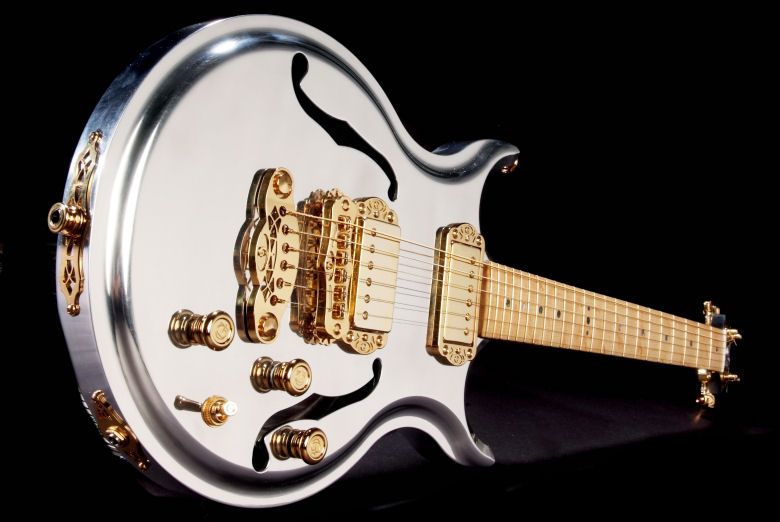
Anthony Goulding unveils his latest aluminium creation

guitarz.blogspot.com:
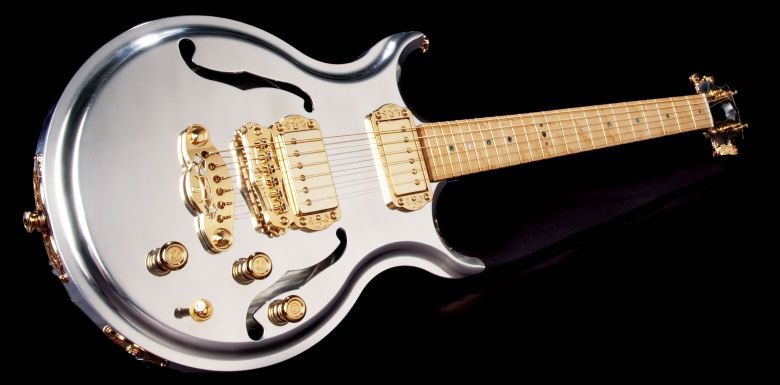
This latest guitar from Goulding Guitars is a real beauty. It has a polished aluminium body and neck, birdseye maple fretboard with gold evo frets, Bareknuckle humbuckers with coiltap, with all hardware/bridge/tailpiece/pickup surrounds/knobs etc designed and made by Anthony Goulding from gold plated brass. The bridge incorporates piezo saddles leading to separate strap pin jack socket, and the total weight is 7lb.

G L Wilson

Guitarz - The Original Guitar Blog - now in its 9th year!

Wednesday, March 24, 2010

Davy Graham’s Fylde Falstaff Guitar

guitarz.blogspot.com:

The legendary and sadly departed folk musician Davy Graham was a highly-innovative guitarist and is often cited as the originator of the DADGAD tuning. I remember seeing him playing a very low-key gig in Oxford circa 1989/1990 and it was a very intriguing, if eccentric, performance. He was using a nylon-strung guitar, and I recall him playing some eastern-sounding sitar-like pieces, and with a lot of tuning changes between songs.

Now one of his guitars from his later musical career is being auctioned off for charity. The following is a press release with all the details:
“Davy’s favourite guitar”

This was one of two guitars made by Fylde in 2005 for Davy to aid his return to professional performance after years of obscurity. Prior to owning this instrument he had been without a steel strung guitar having suffered a break-in at his home that left him without any quality instruments for some years.

This guitar was used for live performances and for recording between 2005 and 2007. It can be heard on “Broken Biscuits” his final album. The guitar is complete with Davy’s own guitar strap and letters of authenticity from Davy’s manager and from Fylde Guitars. It also includes a number of photographs of Davy playing the guitar in different situations and a CD of three tunes recorded on the Falstaff and not released elsewhere.

The guitar has been re-fretted and set up by Fylde especially for this auction, and is fitted with a Headway FEQ pickup. There is some pick wear on the soundboard, and three dents which were caused when Davey knocked over a microphone stand in the studio. These dents have been sealed and partly filled by Fylde. None of this detracts from the guitar, which is otherwise in excellent condition.

The new retail price of the guitar is £2595 plus the pickup at £220, making a total package worth £2815 when new. It is a unique chance to own a historic guitar and could easily be valued at a much higher price. For someone looking for a second hand Falstaff, this guitar comes with the priceless added value of its history and previous owner. For someone thinking of buying a new guitar, this is an excellent alternative, a chance to acquire a piece of history that has been owned and played in by an icon of acoustic guitar playing

All the proceeds from this auction will go to charity, split between the Vaughan Williams Library at Cecil Sharp House, and the Local branch of “MIND”. Both of which were important in Davy’s life. If the sale realises more than the expected amount, other charities may be included in line with Davy’s interests.

Click here to view the ebay listing.
G L Wilson

Guitarz - The Original Guitar Blog - now in its 9th year!

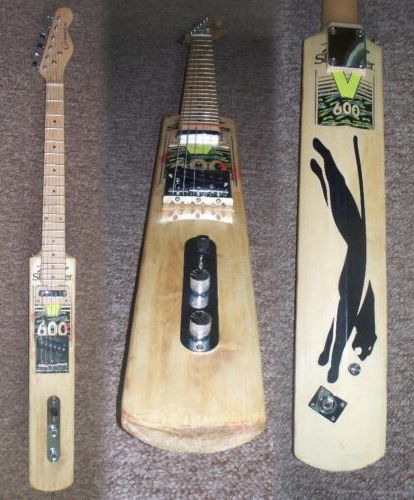
The Coverdrive CF cricket bat guitar

guitarz.blogspot.com:

Colin Flint has combined his love of the sport of cricket, playing guitar and carpentry, to produce the Coverdrive CF cricket bat guitar. The guitars feature Telecaster-style necks and other components mounted into the body of a genuine cricket bat. Some of the guitars he has for sale on his website are built using some quite valuable bats, such as his Signed Slazenger 1977 'Ashes Victory' cricket bat guitar, which is built using an unused bat from the 1977 Ashes series, won 3-0 by England, complete with signatures on the front of England and Australia players.

The guitar pictured here, based on a 1990s Slazenger V600 cricket bat, is currently being offered for sale on eBay.

As a guitar made from an item of sporting equipment, it certainly beats the 2-string tennis racquet guitar we looked at in January.

For more information, please see www.cricketbatguitar.com.

G L Wilson

Guitarz - The Original Guitar Blog - now in its 9th year!

Saturday, March 20, 2010

Adam Black Libra UK

guitarz.blogspot.com:
The Adam Black Guitar Company is a relatively new name to the guitar world. Distributed in the UK by Rosetti, Adam Black offer a very attractively-priced range of acoustic, electric and jazz guitars. Their guitars have been earning some very postive reviews and are already the choice of several bands on the circuit, including old punks Sham 69.

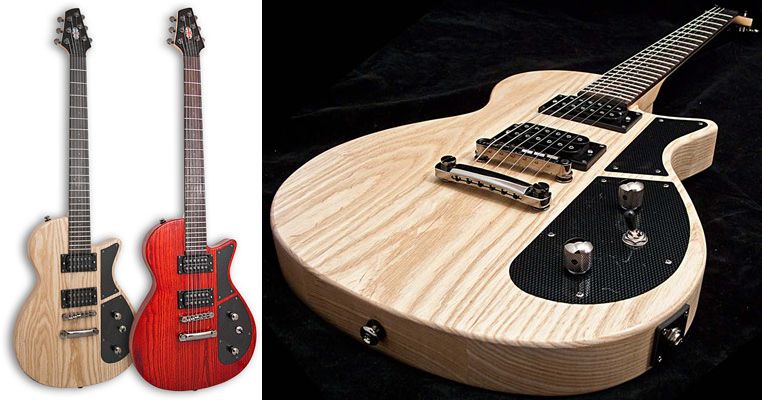
For the most part Adam Black guitars are made in Indonesia (in the former Epiphone factory), but the model pictured above, the Adam Black Libra UK, is built in Braintree, Essex, in the United Kingdom - hence the Union Flag you can see proudly displayed on its headstock. Selling for £399 (inc VAT) in the UK, this surely has got to be the cheapest "Made in Britain" guitar on the market today.

The singlecut body design is reminiscent of the Danelectro U2, but is made from solid North East Ash and has a bolt-on Rock Maple neck with a Fender-esque 25.5" scale length. Pickups are two high output humbuckers with ceramic magnets and are controlled via a simple one volume, one tone and 3-way pickup selector layout. The pickguard and control panel are plastic with an attractive carbon-fibre weave.

For those on more of a budget, Adam Black also offer an Indonesian-built Libra as well as several other models, but I think it's great that their top of the range electric is made in the UK and hope that the model is a success for them.

G L Wilson

Guitarz - The Original Guitar Blog - now in its 9th year!

Friday, March 19, 2010

Burns Scorpion Gothic

bison scorpion

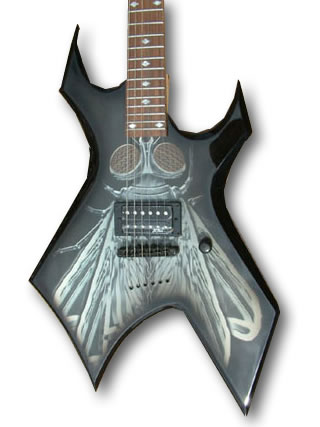
Since we got started on guitars with rear horns, I couldn't avoid to present here the Burns Scorpion, the first one to feature this design if I'm not wrong ; a beautiful vintage chrome plated Burns Scorpion bass was already presented on this blog, so this is the guitar.

The Scorpion was first released in 1979 during the penultimate incarnation of Burns - Jim Burns Actualizers Ltd. - but here is the 2002 reissue by Burns London Ltd., under the Gothic label (something terrible to rock music happened when gothic started to be misused for metal music...) - now it's called the Scorpion Design. This is the hardtail version, it's more common with a Floyd Rose trem.

In 2003 there was a short lived model with golden finish and hardware, definitely too late for glam-rock, I wonder who ever bought it, but some crazy Japanese Visual Kei band (you can see how coherent this blog is!)
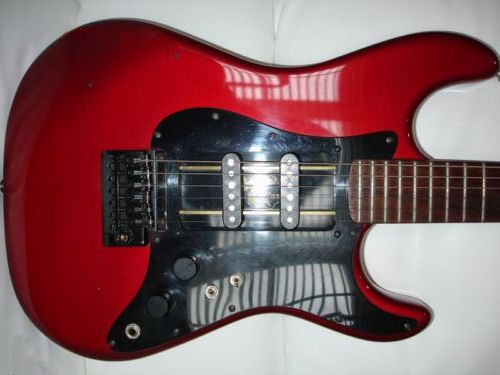
Anyway, the Scorpion is a nice looking guitar for such a radical design, I appreciate the challenge, but it's not as good as the Bison that shares its front horns (in my humble opinion).

bertram

Guitarz - The Original Guitar Blog - now in its 9th year!

Saturday, March 6, 2010

Wilkes "The Answer"

guitarz.blogspot.com:

Bertram was recently asking about pickup placement and nodal points. Well, with a guitar equipped with sliding pickups such as this Wilkes "The Answer" you could experiment to your heart's content.

It's a very clever system. The two coils can be used independently as single coil pickups or together in humbucking mode. And, of course, you can position them just where you want.

These guitars date back to the 1980s and were made in the UK. Wilkes were keen innovators and other intriguing instruments included a fretless bass that incorporated metal slap plates at the top end of the neck and so could facilitate 80s-style slapping and popping on a fretless. (Personally, I'm trying to forget all that scary slapping and popping stuff. I never did understand the appeal of that racket.)

Wilkes Guitars, built by Doug Wilkes, are still in operation and guitars fitted with "The Answer" pickup system are still being produced.

G L Wilson

NB: Please make sure you are reading this Guitarz post at guitarz.blogspot.com and not on a Scraper blog that copies posts without permission (and steals bandwidth) so as to profit from advertising. Please support original bloggers!