guitarz.blogspot.com:
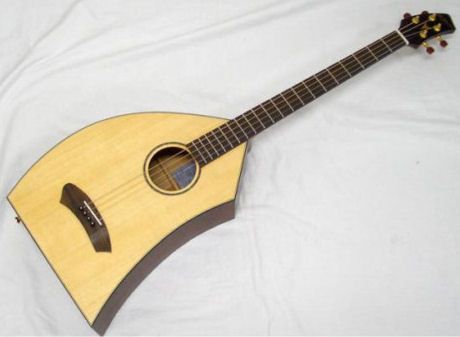
Here's an intriguing 4-string, possibly tenor, guitar from K. Yairi.
K. Yairi, a company overseen by Mr. Kazuo Yairi in Kani, a small community in the mountainside area of Honshu, Japan, are renowned for their high quality acoustic guitars. However, their guitars usually are more conservative in appearance than this one. This particular instrument's scale length of 24.8" puts it into regular guitar scale territory, rather than the usual 23" scale of a tenor guitar. It's an odd one, for sure. Alas, the eBay listing tells us very little about it.
G L Wilson
Guitarz - The Original Guitar Blog - now in its 10th year!
|
|
|
|
|---|
Showing posts with label acoustic. Show all posts
Friday, March 18, 2011
K. Yairi tenor guitar
Wednesday, March 2, 2011
Ozark Galloping Horse acoustic
guitarz.blogspot.com:
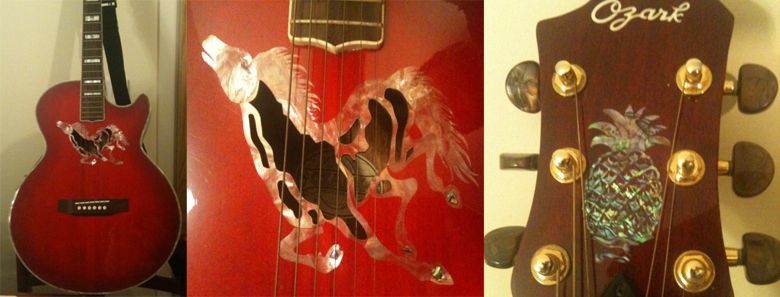
Ozark Guitars produce a fine range of budget to medium-priced acoustic and resonator guitars and other folk instruments such as banjos, mandolins, mandolas and bouzoukis. It's nice to see that they have been having fun with some of their designs, such as the above pictured acoustic with a "galloping horse" soundhole design picked out in inlaid mother of pearl and abalone. Other soundhole designs have included a dolphin, an eagle, and a butterfly. It seems the horse and dolphin designs are now discontinued. I'm not quite sure what relevance the pineapple on the headstock has.
G L Wilson
Guitarz - The Original Guitar Blog - now in its 10th year!
Monday, February 28, 2011
Hurricane Model BF-402
guitarz.blogspot.com:
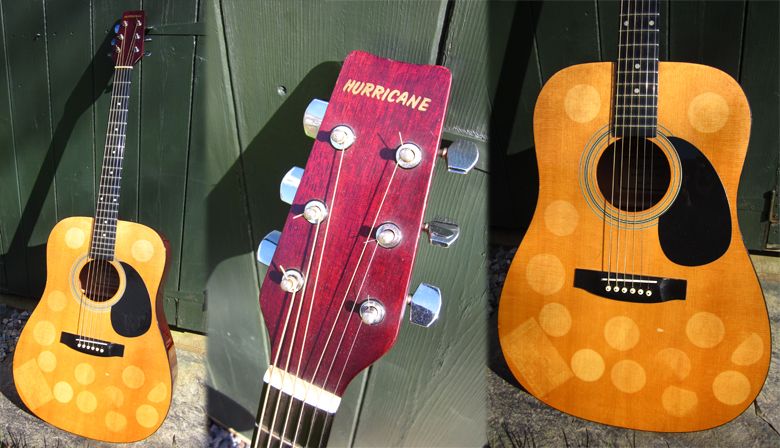
These photos illustrate quite nicely the evil presented by stickers and why they should never be allowed to sully a guitar's appearance. This guitar had its stickers removed after many years and whilst the uncovered finish of the guitar's top had changed to a more golden colour with age, the area beneath the stickers has remained the original colour.
Actually, this is my guitar. I bought it in this condition last week, and despite the above little rant I really am not bothered by its appearance. In a way, it adds character, but more to the point I really don't care because I got an absolute bargain here. It only cost me £20 (OK, call it £30 with post and packing). I don't think anyone else was bidding because of the appearance of the guitar. But, it's a really nice player (much better than my Ovation "thing" with the horrible action and which set me back between £300-£400 a few years back). I can't tell you how pleased I am with this guitar.
But... Has anyone heard of Hurricane guitars? The name sounds familiar, but I can't find out anything much about them. Apparently they made a few of the usual Fender and Gibson solidbody knock-offs. This acoustic was made in Japan - the seller reckoned 1970s but I tend to think 1980s is more likely - and the label inside the soundhole tells us that it's the Model BF-402. It's quite obviously a Martin copy, but its not a top of the range guitar. Witness the simple black binding on the body and total lack of neck binding. The tuners are also of the open-back type, although they function perfectly competently. The Hurricane logo is a quite a simple affair, if you could even call it a logo. It's just the name set in a particular font, and with the individual characters at different heights it looks as if it was designed using LetraSet letters (who remembers LetraSet? They were sheets of transfers that you had to apply to a surface by rubbing and peeling away the backing sheet).
So, anyway, the lesson is keep checking those auctions, and try to see beyond initial appearances.
G L Wilson
Guitarz - The Original Guitar Blog - now in its 10th year!
Tuesday, February 22, 2011
The Serenader from B&J New York
guitarz.blogspot.com:
Alas, the auction for this probably 1930s-era Serenader guitar by B&J New York has already finished. Ren Kay tried to post this on the Guitarz Facebook page, but Facebook - for its own mysterious reasons - moved this into the "spam" list where I didn't find it until the auction was well and truly over.
Serenader was a brandname of B&J New York distributors, B&J standing for Buegeleisen and Jacobson who started business around 1897 in New York city. Their guitars came from a variety of sources, which included the manufacturers Harmony, Kay and Hagström. I'm pretty certain that the guitar we are looking at is a Kay.
The auction listing doesn't tell us much about this particular model other than to describe its physical condition:
G L Wilson
Guitarz - The Original Guitar Blog - now in its 10th year!
Alas, the auction for this probably 1930s-era Serenader guitar by B&J New York has already finished. Ren Kay tried to post this on the Guitarz Facebook page, but Facebook - for its own mysterious reasons - moved this into the "spam" list where I didn't find it until the auction was well and truly over.
Serenader was a brandname of B&J New York distributors, B&J standing for Buegeleisen and Jacobson who started business around 1897 in New York city. Their guitars came from a variety of sources, which included the manufacturers Harmony, Kay and Hagström. I'm pretty certain that the guitar we are looking at is a Kay.
The auction listing doesn't tell us much about this particular model other than to describe its physical condition:
Six stringed guitar, gold glittered pick guard.That "steel bar at the side" would appear to be a Teisco (or similar) gold foil pickup. Yep, someone has had a go at electrifying this old (not quite antique) guitar. Witness also two pots - without knobs - and an output jack behind the guitar's bridge. But... What's the deal with the weird location of the pickup? Shouldn't it be under the strings? My guess is that the pickup is so microphonic that it works just about anywhere.
The finish is worn at the base of the guitar.
Visible markings to this area as well.
The wood is a very nice rich brown in color.
Uncertain of the wood used. There are two areas
where the edges are chipped, black and white pos. celluloid edging.
There is a neck pull to the guitar, no visible splits in the body.
There are nineteen frets in total, I see a few deep scratches in the wood.
The steel bar at the side has one missing screw.
This guitar was likely made sometime in the 1930s though sort of hard to pinpoint.
The guitar measures approx. 36.5" L X 13.5" W.
G L Wilson
Guitarz - The Original Guitar Blog - now in its 10th year!
Jim Davies' electrified 5-string acoustic
Jim Davies, bassist with Small Machine writes:
Oh, and on an unrelated note, I'd just like to point out that yesterday we exceeded one million page hits - which is nice. Remember, there were no other guitar blogs when I started this one. I'm just pleased that so many people seem to like it, bearing in mind that I originally started it only so as to keep track with guitar-related items I'd found when surfing the web.
G L Wilson
Guitarz - The Original Guitar Blog - now in its 10th year!
I sometimes comment on the Guitar Blog and I thought I'd send in this - your comment on the Burns/Hayman guitar, "I've always liked acoustics that have obviously been electrified with pickups and control knobs on show for all to see" spurred me into photographing and videoing one of my own guitars for submission for your blog.Hey Jim, great stuff. Thanks for sharing it with us. I guess this is the same kind of do it yourself ethos as displayed by cigar box guitar builders. I'm reminded also of Seasick Steve, who besides playing his "3-string trance wonder" also often riffs upon a beaten-up old parlour guitar with a Teisco pickup screwed into the top - and it sounds fantastic.
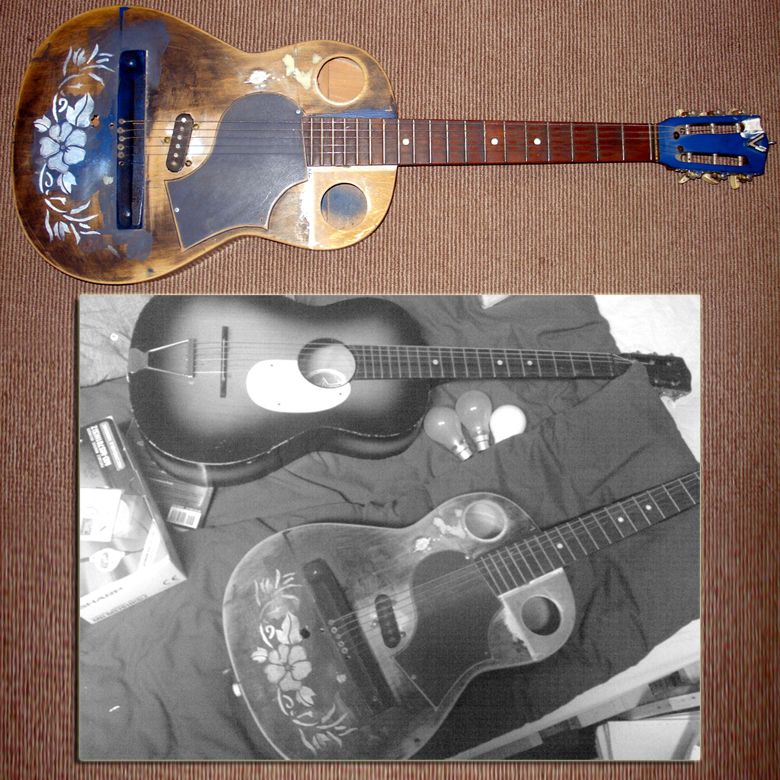
The attached photos are of an old acoustic that has been "modified" over the years by me, The original guitar was sunburst, made in Eastern Europe model with a white scratchplate, trapeze type tailpiece and no bridge (or strings). Over the years different paint finishes and hardware have been added to the guitar, including a pickup from a Japanese Telecaster copy (wired straight to a jack) and homemade bridge, scratchplate and soundholes. I keep it in an open-E tuning based on the "Keith Richards" open G, so it only needs 5 strings. The strings come out of the big bridge straight onto the wood - there is no saddle - which lends the guitar a sitar-type quality.
I made a YouTube video so that you can hear what it sounds like amplified and acoustically too.
I used to think that perhaps I had gone too far with the things I had done to the guitar, but a few years ago I found an unmodified version of the same guitar in a charity shop. I bought it, got it home, put new machine heads on and strung it with new strings and realised why I had gone to such lengths to change the original; it sounded awful! Attached also is a cameraphone photo of the two together [inset, above].
Regards
Jim Davies
Oh, and on an unrelated note, I'd just like to point out that yesterday we exceeded one million page hits - which is nice. Remember, there were no other guitar blogs when I started this one. I'm just pleased that so many people seem to like it, bearing in mind that I originally started it only so as to keep track with guitar-related items I'd found when surfing the web.
G L Wilson
Guitarz - The Original Guitar Blog - now in its 10th year!
Monday, February 21, 2011
Antique Italian harp guitar
guitarz.blogspot.com:
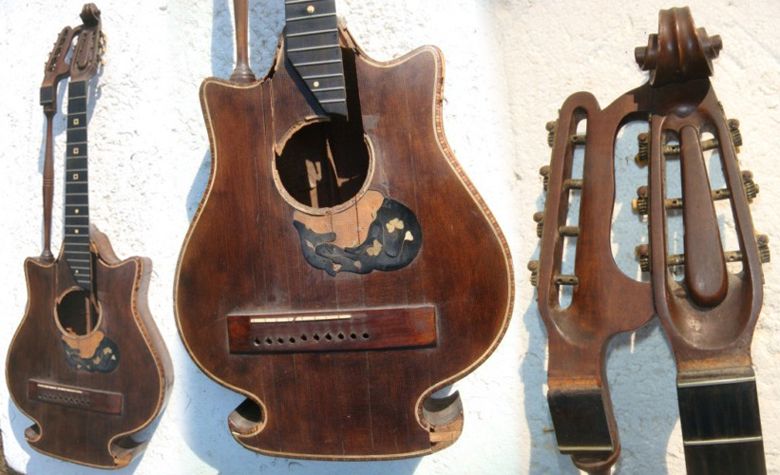
Exciting and interesting guitar design is nothing new. This incredible looking instrument is an Italian harp guitar from the early 1900s. An internal label gives the name Carmelo Pinocchiaro. It would originally have had six strings plus four sub-basses. Sadly, as you can see from the photos, it's not exactly in a very good state of repair. Let's hope someone buys this up and restores it. It does require some skilled luthier attention, even if it is remain as a museum piece.
G L Wilson
Guitarz - The Original Guitar Blog - now in its 10th year!
Labels:
acoustic,
antique guitars,
harp guitar,
vintage guitars
Sunday, February 20, 2011
Unusual antique guitar
guitarz.blogspot.com:
Apologies, but here is yet another guitar about which I know nothing! It is being sold on eBay by a French seller who tells us:
Still, it's an interesting piece and worth recording for posterity on this blog.
G L Wilson
Guitarz - The Original Guitar Blog - now in its 10th year!
Apologies, but here is yet another guitar about which I know nothing! It is being sold on eBay by a French seller who tells us:
Rare ancienne guitare, forme peu courante, usures et petits manques d'usage....which doesn't tell us much more other than its supposed rarity and its length.
Longueur de la caisse 435 mm longueur totale 900 mm.
Usures d'usages et du temps.
Still, it's an interesting piece and worth recording for posterity on this blog.
G L Wilson
Guitarz - The Original Guitar Blog - now in its 10th year!
Monday, February 14, 2011
Vintage Hofner archtop acoustic
guitarz.blogspot.com:
This vintage Hofner archtop acoustic caught my eye on eBay. Despite asking a Buy It Now price of $1,500, the seller offers no information about it other than it's "All Original, never modded." Hhhhhmmmm, for that kind of money I think I'd want a bridge. But anyway, I digress. Does anyone out there know the model? And is that a third soundhole or is it a diamond-shaped label?
G L Wilson
Guitarz - The Original Guitar Blog - now in its 10th year!
This vintage Hofner archtop acoustic caught my eye on eBay. Despite asking a Buy It Now price of $1,500, the seller offers no information about it other than it's "All Original, never modded." Hhhhhmmmm, for that kind of money I think I'd want a bridge. But anyway, I digress. Does anyone out there know the model? And is that a third soundhole or is it a diamond-shaped label?
G L Wilson
Guitarz - The Original Guitar Blog - now in its 10th year!
Labels:
acoustic,
archtop,
German guitars,
Hofner,
vintage guitars,
What's that guitar?
Sunday, February 13, 2011
Burns/Hayman prototype hybrid guitar
guitarz.blogspot.com:
Am I the only one who thinks that modern electro acoustics and and hybrid guitars look just too sterile? I really never did like this business of hiding away all the gubbins. "Oh, you can't have any visible pickups or control knobs, that'll spoil the illusion of this being an acoustic guitar." Huh! As if those horrible little slider controls they stick on the rim of an electro acoustic are any kind of replacement!
I've always liked acoustics that have obviously been electrified with pickups and control knobs on show for all to see. They can have a rather Heath Robinson appeal sometimes (Oh, if only Heath Robinson had designed a guitar!), but to me they seem all the more honest, as if to say, "Yes, this is an acoustic but it's hardly unplugged!"
Think John Lennon with his Gibson J-160E, Nirvana's Kurt Cobain playing supposedly "unplugged" with a Martin D-18E, or John Martyn with a Martin guitar with pickups obviously gaffer-taped to the guitar creating loops on an Echoplex machine (as if an acoustic could do that without all the electrickery!).
So... the above pictured one-off Burns/Hayman prototype is a guitar that I find mightily appealing. It's an acoustic/electric hybrid guitar that proudly displays its electric components for all to see. I like the electric style compensated bridge set into an acoustic style "moustache" - that's a nice touch. Actually, I doubt that acoustically this guitar is very loud at all - looking at the picture of the back of the guitar (I'll put some more photos in the comments) it does appear to have a very shallow body. It's like they took the Burns Steer guitar, and made it a little bit more acoustic-y.
I don't really have much info on this guitar other than what the eBay seller tells us (hey, it is a rarity), so let's quote from the listing:
G L Wilson
Guitarz - The Original Guitar Blog - now in its 10th year!
Am I the only one who thinks that modern electro acoustics and and hybrid guitars look just too sterile? I really never did like this business of hiding away all the gubbins. "Oh, you can't have any visible pickups or control knobs, that'll spoil the illusion of this being an acoustic guitar." Huh! As if those horrible little slider controls they stick on the rim of an electro acoustic are any kind of replacement!
I've always liked acoustics that have obviously been electrified with pickups and control knobs on show for all to see. They can have a rather Heath Robinson appeal sometimes (Oh, if only Heath Robinson had designed a guitar!), but to me they seem all the more honest, as if to say, "Yes, this is an acoustic but it's hardly unplugged!"
Think John Lennon with his Gibson J-160E, Nirvana's Kurt Cobain playing supposedly "unplugged" with a Martin D-18E, or John Martyn with a Martin guitar with pickups obviously gaffer-taped to the guitar creating loops on an Echoplex machine (as if an acoustic could do that without all the electrickery!).
So... the above pictured one-off Burns/Hayman prototype is a guitar that I find mightily appealing. It's an acoustic/electric hybrid guitar that proudly displays its electric components for all to see. I like the electric style compensated bridge set into an acoustic style "moustache" - that's a nice touch. Actually, I doubt that acoustically this guitar is very loud at all - looking at the picture of the back of the guitar (I'll put some more photos in the comments) it does appear to have a very shallow body. It's like they took the Burns Steer guitar, and made it a little bit more acoustic-y.
I don't really have much info on this guitar other than what the eBay seller tells us (hey, it is a rarity), so let's quote from the listing:
Rare Virginian hybrid guitar designed by Barry Gibson and Keith West of Burns London Ltd. featuring:I'm actually surprised it's as recent as that; it looks older. Anyway, it has a starting price of £249 on it and a But It Now price of £850.A real collectors piece for Burns/Hayman fans 1 only made as this model was never put into production. The guitar was made over 12 years ago in the U.K. and has been sitting in the Burns warehouse since then, untouched.
- Burns Rezo-Matik pick-ups
- Solid Spruce Top
- Rosewood back and sides
- Burns badged Gotoh tuners
- Burns Tortoiseshell bridge section
G L Wilson
Guitarz - The Original Guitar Blog - now in its 10th year!
Labels:
acoustic,
Burns,
cool guitars,
Hayman,
hybrid guitar,
one-offs,
prototypes
Friday, February 11, 2011
Interesting 'slide' technique with fingers!
This is Ronnie from Botswama who has a really interesting playing technique! I'll let the video do the talking, just click "play" already!
Thanks to Marty Jensen for recommending this clip.
Thanks also to Paul Bob for pointing me in the direction of a better quality version of the video than the one I posted pre-edit.
G L Wilson
Guitarz - The Original Guitar Blog - now in its 10th year!
Thanks to Marty Jensen for recommending this clip.
Thanks also to Paul Bob for pointing me in the direction of a better quality version of the video than the one I posted pre-edit.
G L Wilson
Guitarz - The Original Guitar Blog - now in its 10th year!
Labels:
acoustic,
Guitar Technique,
slide guitar,
video,
YouTube
Wednesday, January 26, 2011
Framus 5/51 acoustic single f-hole model from 1969
guitarz.blogspot.com:
Here's a sweet little guitar from Germany: a Framus 5/51 archtop with - unusually for an acoustic guitar - just a single f-hole on the bass side. As is commone with old Framus guitars, the neck is made from multiple laminates, and is also a bolt-on - proof that it wasn't just the Italians (Eko, etc) who used this construction technique on their acoustics.
G L Wilson
Guitarz - The Original Guitar Blog - now in its 10th year!
Labels:
acoustic,
archtop,
Framus,
German guitars,
vintage guitars
Monday, January 3, 2011
Stamp collection on a Columbus acoustic
guitarz.blogspot.com:
Ah, I love stuff like this! It's an 1970s-era Columbus acoustic which has been personalized with someone's stamp collection! (The seller says this is a 60s guitar, but I'd argue that 70s was more likely.) As a relatively budget-priced Japanese-made guitar from this era, you might argue that the stamp collection (all from approx 40 years ago) might be more valuable than the guitar itself.
See also this stamp-covered electric that we have previously featured on this blog.
G L Wilson
Guitarz - The Original Guitar Blog - now in its 10th year!
Labels:
acoustic,
Columbus,
Japanese guitar,
one-offs,
vintage guitars
Monday, December 27, 2010
Dobro Model 66 from the 1930s
guitarz.blogspot.com:
This highly decorated 1930-era Dobro Model 66 seems to be a very appropriate guitar to show during this festive season. It's a wooden-bodied resonator guitar with a square neck for lap steel playing. The decorative design has been applied through the process of sandblasting. The body would have been made from mahogany plywood with a neck of mahogany and an ebonized (i.e. artificially blackened) rosewood fingerboard. In its day this would have been Dobro's top of the line instrument, and was also available as a roundneck guitar for what we nowadays consider to be the more conventional "Spanish" style of playing.
G L Wilson
Guitarz - The Original Guitar Blog - now in its 9th year!
Labels:
acoustic,
Dobro,
lap steel,
resonator,
slide guitar,
vintage guitars
Tuesday, December 14, 2010
1915 Dyer Harp Guitar
guitarz.blogspot.com:
On Friday we looked at a modern replica of a W.J. Dyer & Bro Harp Guitar, and here we see the real thing!
This Dyer "Symphonic Guitar" dates from 1915 and is therefore too late to have been made by Chris Knutsen. Possibly it's one of the Larson Brothers' Dyers.
For info, here's the text of the listing on eBay where it is being offered for sale with a Buy It Now price of $29,000:
Guitarz - The Original Guitar Blog - now in its 9th year!
On Friday we looked at a modern replica of a W.J. Dyer & Bro Harp Guitar, and here we see the real thing!
This Dyer "Symphonic Guitar" dates from 1915 and is therefore too late to have been made by Chris Knutsen. Possibly it's one of the Larson Brothers' Dyers.
For info, here's the text of the listing on eBay where it is being offered for sale with a Buy It Now price of $29,000:
Here's something you don't see everyday. An original American made Dyer #8 harp guitar made in (approximately) 1915. This was the top-of-the-line Dyer harp guitar and is considered the "holy grail" of harp guitars. In fact there are only 12 known to exist! This particular guitar has a custom side carving veneer (seemingly original by the look of the finish) that has never been seen before, making it truly unique. It is completely playable and is entirely original, except for some small pieces of the elaborate "tree of life" inlay expertly replaced by the genius of pearl inlay, Larry Robinson, some replaced bridge pins and a replaced fretwire saddle. In addition there is some minimal finish touchup around the original bridge by master luthier Chris Berkov, as well as a thorough cleaning and setup by Dexter Johnson of Carmel music. Sounds incredible with excellent playability. This is a true find and will be an amazing addition to any world-class guitar collection. Comes with a brand new custom Cedar Creek hard shell case.G L Wilson
More details are available on page 274 of George Gruhn's Acoustic Guitars, and at: http://harpguitars.net/blog/2010/09/a-custom-dyer-8/
Guitarz - The Original Guitar Blog - now in its 9th year!
Labels:
acoustic,
harp guitar,
vintage guitars,
W.J. Dyer and Bro
Friday, December 10, 2010
The Gibson harp guitar
guitarz.blogspot.com:
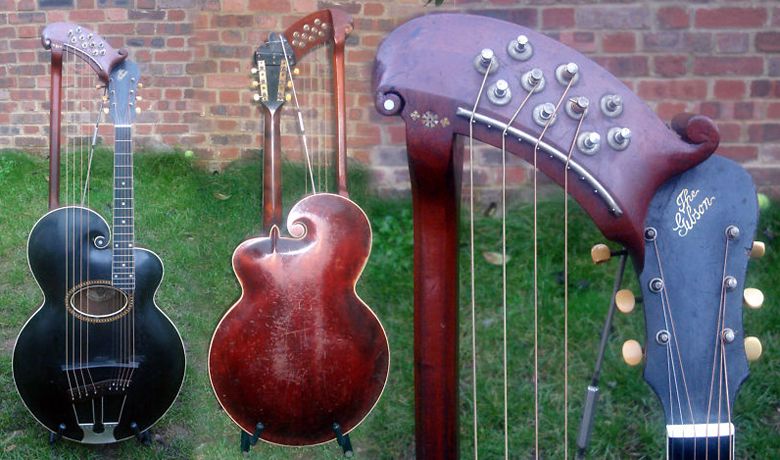
This circa 1920 Gibson harp guitar is of a completely different design to the Knutsen Dyer replica we saw in the previous blog post. Instead of having a hollow body extension to support the sub-bass strings, it has a solid support which is almost equivalent to a second neck. You'll notice that this example, currently being offered for sale on eBay, does not have the full complement of sub-bass strings. The neck is also currently strung left-handed, which must have severely limited its playability given the body shape (open chords and some barre chords at the lower reaches of the neck would have been about its limit).
For more fascinating variations on a theme - and there are many - take a look at the excellent harpguitars.net.
G L Wilson
Guitarz - The Original Guitar Blog - now in its 9th year!
Knutsen Dyer-style harp guitar
guitarz.blogspot.com:
Here we have a very nice example of a Knutsen Dyer-style harp guitar built by Alejandro Vasquez Rubio. The design of this "one-arm harp guitar" was patented in 1897 by Chris Knutsen, who was contracted to build guitars for W.J. Dyer & Bro in 1899. However Dyer switched to the services of the Larson Brothers in 1902, allegedly because their guitars were more consistent whereas Knutsens were all one-offs and could vary considerably from one example to the next.
G L Wilson
Guitarz - The Original Guitar Blog - now in its 9th year!
Labels:
acoustic,
Alejandro Vasquez Rubio,
harp guitar,
Knutsen,
Luthiers,
replicas,
W.J. Dyer and Bro
Friday, November 19, 2010
Framus Camping guitar
guitarz.blogspot.com:
This Framus Camping guitar from 1968 is an acoustic guitar that could only ever have come out of Europe. Its style is quite distinctly different from anything from the American market which more often than not conformed to the law of C.F. Martin. Likewise, Japanese and other Far Eastern-made acoustic guitars were inspired by the American way of doing things.
European makers, however, were happy doing their own thing. This Framus is a perfect example, being a flat-top guitar but with the floating bridge and trapeze tailpiece you'd notmally expect to find on an archtop, and with a parlour-like 12-fret neck on a wider, more rounded body.
This, of course, is all topped off by the simple artwork depicting a scene of tents pitched along a lakeside with mountains in the background. It's very North European, very German! It's a charming little guitar, and one which the seller describes as having a sweet action and an effortless playability.
G L Wilson
Guitarz - The Original Guitar Blog - now in its 9th year!
Tuesday, November 16, 2010
Marshall... "Bluesbreaker" acoustic guitar???
guitarz.blogspot.com:
The name Marshall should need no introduction to anyone interested in guitars or rock music in general. The amplifiers produced by this now legendary British company are almost omnipotent on stages around the world and have been used by just about everybody.
The name is so well known but it's unusual to see it actually on a guitar - and an acoustic guitar at that! This particular Marshall Bluesbreaker acoustic guitar is currently being offered for sale on eBay, although unfortunately has sustained some damage to its rear. These were distributed by Rose Morris (I'd guess in the 1970s) and were - the seller claims - actually made in Italy by Eko. The eagle-eyed will notice that this Marshall Bluesbreaker is nearly identical to the Eko Ranger other than having a different shaped headstock and - of course - the Marshall name applied to it.
However, I'm wondering if perhaps they were made by Fratelli Fuselli (Fuselli Brothers) who produced the E-ROS Dakota fashioned after the Eko Ranger design? I'd say there was more of a resemblance.
G L Wilson
Guitarz - The Original Guitar Blog - now in its 9th year!
Labels:
acoustic,
Eko,
folk instruments,
Italian guitars,
Marshall,
vintage guitars
Tuesday, November 9, 2010
Maywa Denki - Big in Japan
guitarz.blogspot.com:

We've featured art-guitars before (The Destroyer and the Les Paul-playing sparrows spring to mind) but I'd like to bring to your attention another little artistic gem - and to recount a little of my rather relaxed Sunday.
In the magazine there are unusual instruments played by the likes of musician/artist Maywa Denki, for instance, that combines guitars, electronics, art and comedy (well, I assume it's meant to be funny). I've not heard much of him before (apart from his Otamatone, the musical tadpole) but he seems to be quite "Big In Japan", he he!
Back to my day: I spent a jolly morning listening to electronic music, the afore mentioned tinkering, making a rabbit and sausage casserole and after lunch - after the siesta after lunch that is - I spent a pleasant afternoon Youtubing Gakken, Maywa Denki and weird Japanese videos - with a slight diversion to the astounding, and apparently nice lads, Muse.
Anyway... this impressive, though for him quite conventional, video is a great example of his inventiveness. It's a bit long and the best bit doesn't kick in till 2 minutes into the video. But it's worth it.
As a viewer with the rather telling nom de plume of Merzbowxnoise says "Everything is possible in Japan!"
I can't see Sir Eric Clapton taking up this contraption just yet.

In the land of the self playing guitar machines, the one armed guitarist is king. I think Tom Waits said that
We've featured art-guitars before (The Destroyer and the Les Paul-playing sparrows spring to mind) but I'd like to bring to your attention another little artistic gem - and to recount a little of my rather relaxed Sunday.
When not following the antics of the Papal entourage in this beautiful and still quite Catholic city (today the Sagrada Familia is officially a bona fide church), I found myself tinkering round with a Gakken SX 150 synthesiser kit - bought a while back but not really explored in any depth. With the kit came a thick, glossy magazine cum instruction brochure.
I hadn't take much notice of the magazine before as it's in Japanese and obviously hard to understand. Actually a lot of it is about nutty japanese artist/musicians so it's all but impossible to understand - probably even to the Japanese.
That may not be totally fair because it does actually look really quite fascinating. "LOOKS" is the operative word in a lot of the instruments featured in the magazine. It wasn't obvious at first but a lot of Gakken's instruments are quite experimental with an emphasis on the "mental".
In the magazine there are unusual instruments played by the likes of musician/artist Maywa Denki, for instance, that combines guitars, electronics, art and comedy (well, I assume it's meant to be funny). I've not heard much of him before (apart from his Otamatone, the musical tadpole) but he seems to be quite "Big In Japan", he he!
Back to my day: I spent a jolly morning listening to electronic music, the afore mentioned tinkering, making a rabbit and sausage casserole and after lunch - after the siesta after lunch that is - I spent a pleasant afternoon Youtubing Gakken, Maywa Denki and weird Japanese videos - with a slight diversion to the astounding, and apparently nice lads, Muse.
Anyway... this impressive, though for him quite conventional, video is a great example of his inventiveness. It's a bit long and the best bit doesn't kick in till 2 minutes into the video. But it's worth it.
As a viewer with the rather telling nom de plume of Merzbowxnoise says "Everything is possible in Japan!"
I can't see Sir Eric Clapton taking up this contraption just yet.
Rock on! David from Sacred Barcelona
Guitarz - The Original Guitar Blog - now in its 9th year!
Wednesday, October 27, 2010
Vintage Parlour Guitar with Hopf pickup
guitarz.blogspot.com:

I'm the first to admit I don't know much about parlour guitars (except that they are smaller. I know that much) and I'm not entirely convinced this seller does either but here's what he says...
"Rare, pre war parlour guitar with extreme RARE HOPF SPEZIAL pickup system made in Germany in the 1920s/1930s. The guitar is made of solid woods: (spruce top , maple body, maple neck) with rare HOPF SPEZIAL pickup
The instrument comes from my collection ! The guitar was not repaired or modified. Everything is in original condition."
And it is, as any self respecting haus frau would say, dirty, dirty, dirty!
Too right it's in original condition (assuming the original owner lived outdoors for the last 70 years and assuming the manufacturer included in the original spec, a twisted metal bar, a chunk of grey plastic cable, an old on/off switch and volume knob from grandad's valve radio and an old metal box all screwed to the front of the instrument).
At 750 Bucks (478 Sovs to us Limeys), this seller is definitely in the "optimistic" end of the market. A couple of months back I eBayed one of these pickups with a Hofner logo plus a chromed scratchplate with two more pickups in the same design with the Ideal logo for about £100 including delivery. Discounting £100 (to be generous) for the extremely rare pickup that leaves us with about £378 for an unknown (though admittedly oddly attractive) make of acoustic guitar in dubious condition with a big crack and various holes drilled in the front. Get on over to eBay and hit that BIN button before I do!
Subscribe to:
Posts (Atom)


