Powered by Blogger.
Guitar Classic
Classic Guitar
Guitar Bass
Showing posts with label harp guitar. Show all posts

Sunday, March 20, 2011

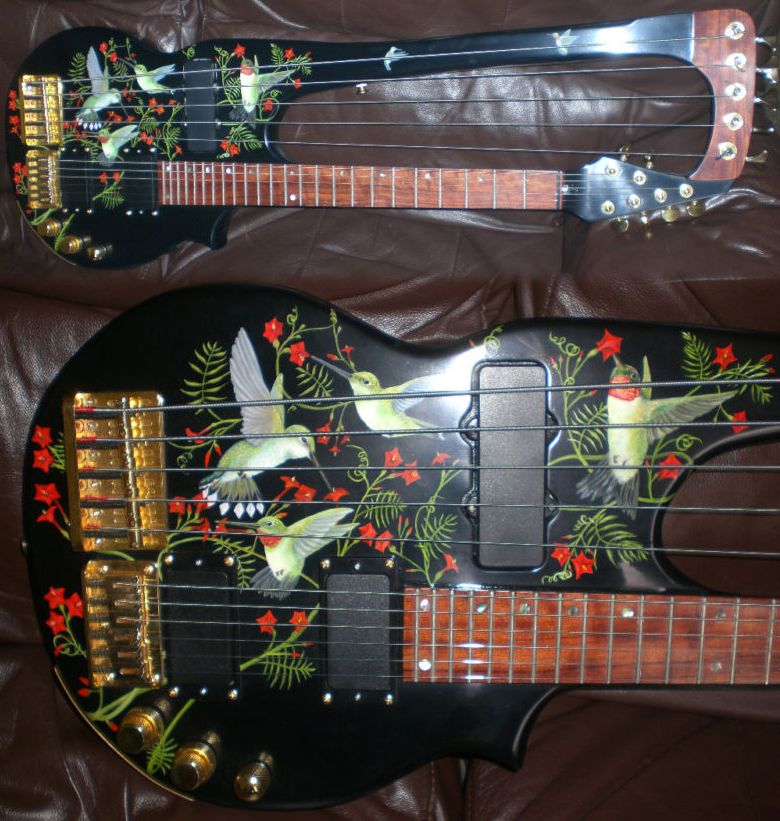
Electric harp guitar, handmade in Hastings, UK

guitarz.blogspot.com:
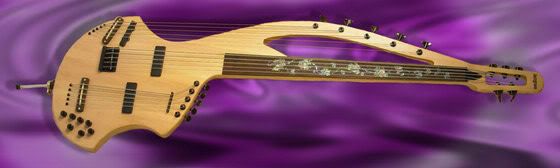
Now here's something a little bit different, an electric harp guitar with a six-string guitar neck plus five sub-bass strings. I'll copy the specs from the listing:
Hand carved from a single piece of Obeche with Bubinga fingerboard and headstock veneer.

Guitar scale length-25.5". Zero radius(flat)fingerboard. Medium frets.

Grover guitar tuners.

Kent Armstrong PAF and PAF+ guitar pickups.

Humbucking Bass pickup.

Stacked volume and tone controls with Sprague orange drop capacitors.

Separate jack outputs. Seperate bass and guitar amps are recommended for the best sound.

Handpainted Hummingbird scene by american artist Cynthia McGinnis.

Gold hardware.

Custom pickup wiring with 5way rotary switch for humbucking/single coil selection.
G L Wilson

Guitarz - The Original Guitar Blog - now in its 10th year!

Monday, February 21, 2011

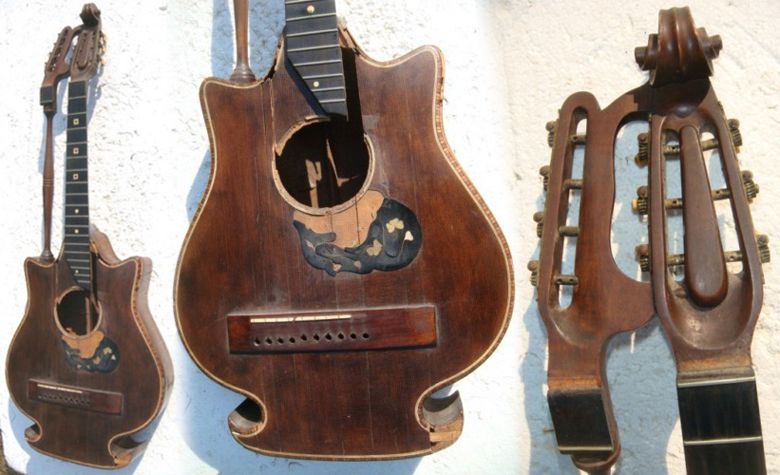
Antique Italian harp guitar

guitarz.blogspot.com:
Exciting and interesting guitar design is nothing new. This incredible looking instrument is an Italian harp guitar from the early 1900s. An internal label gives the name Carmelo Pinocchiaro. It would originally have had six strings plus four sub-basses. Sadly, as you can see from the photos, it's not exactly in a very good state of repair. Let's hope someone buys this up and restores it. It does require some skilled luthier attention, even if it is remain as a museum piece.

G L Wilson

Guitarz - The Original Guitar Blog - now in its 10th year!

Tuesday, December 14, 2010

1915 Dyer Harp Guitar

guitarz.blogspot.com:

On Friday we looked at a modern replica of a W.J. Dyer & Bro Harp Guitar, and here we see the real thing!

This Dyer "Symphonic Guitar" dates from 1915 and is therefore too late to have been made by Chris Knutsen. Possibly it's one of the Larson Brothers' Dyers.

For info, here's the text of the listing on eBay where it is being offered for sale with a Buy It Now price of $29,000:
Here's something you don't see everyday. An original American made Dyer #8 harp guitar made in (approximately) 1915. This was the top-of-the-line Dyer harp guitar and is considered the "holy grail" of harp guitars. In fact there are only 12 known to exist! This particular guitar has a custom side carving veneer (seemingly original by the look of the finish) that has never been seen before, making it truly unique. It is completely playable and is entirely original, except for some small pieces of the elaborate "tree of life" inlay expertly replaced by the genius of pearl inlay, Larry Robinson, some replaced bridge pins and a replaced fretwire saddle. In addition there is some minimal finish touchup around the original bridge by master luthier Chris Berkov, as well as a thorough cleaning and setup by Dexter Johnson of Carmel music. Sounds incredible with excellent playability. This is a true find and will be an amazing addition to any world-class guitar collection. Comes with a brand new custom Cedar Creek hard shell case.

More details are available on page 274 of George Gruhn's Acoustic Guitars, and at: http://harpguitars.net/blog/2010/09/a-custom-dyer-8/
G L Wilson
Guitarz - The Original Guitar Blog - now in its 9th year!

Friday, December 10, 2010

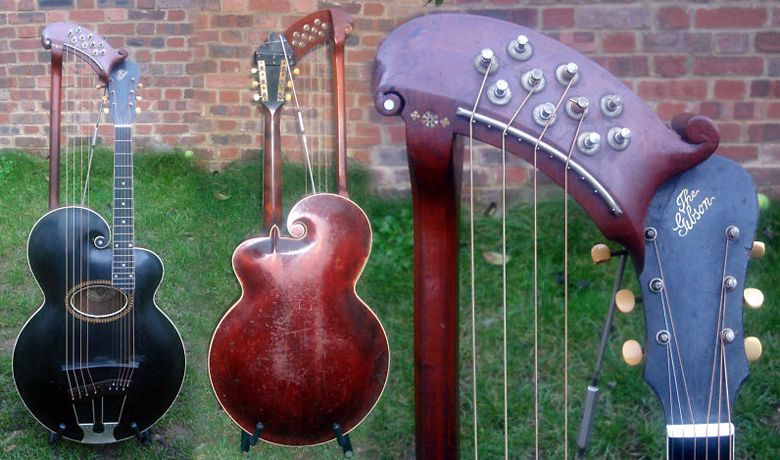
The Gibson harp guitar

guitarz.blogspot.com:
This circa 1920 Gibson harp guitar is of a completely different design to the Knutsen Dyer replica we saw in the previous blog post. Instead of having a hollow body extension to support the sub-bass strings, it has a solid support which is almost equivalent to a second neck. You'll notice that this example, currently being offered for sale on eBay, does not have the full complement of sub-bass strings. The neck is also currently strung left-handed, which must have severely limited its playability given the body shape (open chords and some barre chords at the lower reaches of the neck would have been about its limit).

For more fascinating variations on a theme - and there are many - take a look at the excellent harpguitars.net.

G L Wilson

Guitarz - The Original Guitar Blog - now in its 9th year!

Knutsen Dyer-style harp guitar

guitarz.blogspot.com:
Here we have a very nice example of a Knutsen Dyer-style harp guitar built by Alejandro Vasquez Rubio. The design of this "one-arm harp guitar" was patented in 1897 by Chris Knutsen, who was contracted to build guitars for W.J. Dyer & Bro in 1899. However Dyer switched to the services of the Larson Brothers in 1902, allegedly because their guitars were more consistent whereas Knutsens were all one-offs and could vary considerably from one example to the next.

G L Wilson

Guitarz - The Original Guitar Blog - now in its 9th year!

Sunday, August 1, 2010

A brief history of the classical guitar

guitarz.blogspot.com:

This is a guest post by Christopher Davis, author of The Classical Guitar Blog

Our instrument has a long history. Dating all the way back to 1400s when an instrument called the Vihuela flourished in Spain. Vihuela featured six courses of strings - a course being a pair of strings tuned to the same pitch in this case. Much like today's guitars, the tuning was fourths and one third. In today's terms, Vihuela tuning would be E A D F# B E.


Interestingly, vihuela was really a family of instruments: they came in all sizes. There are only three original Vihuelas in existence today, and each is slightly different in scale length and pitch. Some would even be considered bass-like. There was also a four course guitar that flourished in France during the Renaissance.

The Baroque guitar (around 1600-1800) flourished in many European countries. These guitars are as much works of art as they are instruments. They featured extensive ornamentation and inlays.


And elaborate rosettes that filled the sound hole.


Around 1800 guitar builders gradually added a sixth course, and went to single strings. Check out this instrument, a six course guitar built around 1800.


And this one built just a few years later.


Like guitarists today, guitarists in the later 1800s explored guitars with more than six strings. Composer/Guitarist Johann Kaspar Mertz played on a ten-string instrument similar to the modern harp guitar.


Napoleon Coste also added more strings and wrote music for this seven string guitar.

The ten-string guitar is still alive today thanks to the work of Narciso Yepes.


Classical, nylon-strung guitars today, however, are mostly pretty tame. And they're all descendents of the grand-daddy of the modern guitar, Antonio Torres. Torres built guitars in Spain during the late 19th century, and his instruments are the first that we consider modern. The bodies on his instruments were slightly bigger, and the braces on the underside of the top were arranged in a fan.


While electric guitars may feature gorgeous wood on the top, the back and sides of a classical guitar are often the most beautiful. Below is my guitar, built in 2009 by Michael Thames.


Most professional level classical guitars - called "concert guitars" - are custom shop jobs. They are built specifically for one person, and you choose a guitar builder based on the features you want. Some builders specialize is construction methods that are a bit unorthodox or strange. Check out the inside of this "lattice braced" guitar.


The tops on these guitars are extremely thin (you could puncture it with your finger), and that black stuff inside is carbon fiber. Another popular construction method today is a "double top". These guitars have a thin top, then a layer of honey-comb style material called Nomex, then another thin top is glued on the other side. Here builder John H. Dick shows off the inside of his guitar tops (towards the end).


There's a lot out there in the world of classical and nylon-strung guitars, and it's well worth exploring.


Christopher Davis

Guitarz - The Original Guitar Blog - now in its 9th year!

Saturday, July 3, 2010

The guitars of Christian Blandhoel

guitarz.blogspot.com:

Christian Blandhoel is a Norwegian visual and audio artist.

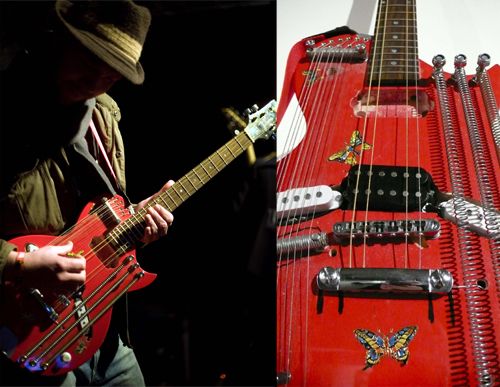
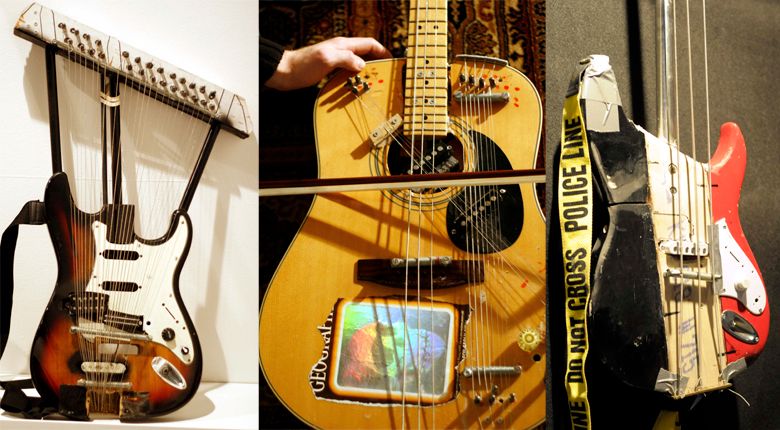
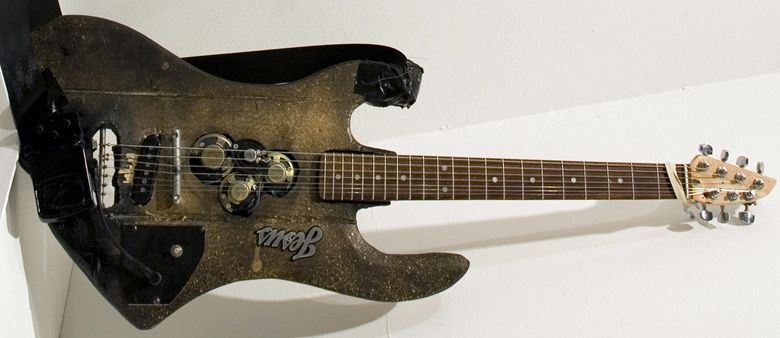
He has quite a collection of self-customised guitars which form his "Sonics" series of art works. These aren't guitars for conventional playing. They can have any number of strings, oddly-positioned pickups, springs as bass strings, pickups behind the bridge, etc. Some don't even seem to have a neck as such.

For more of his work please see here and for the guitars specifically here. Much of it is in Norwegian, but I still found plenty to look at and thought it was utterly fascinating.


G L Wilson

Guitarz - The Original Guitar Blog - now in its 9th year!

Tuesday, June 29, 2010

Breyer Hermanos 1910 11-string classical

guitarz.blogspot.com:
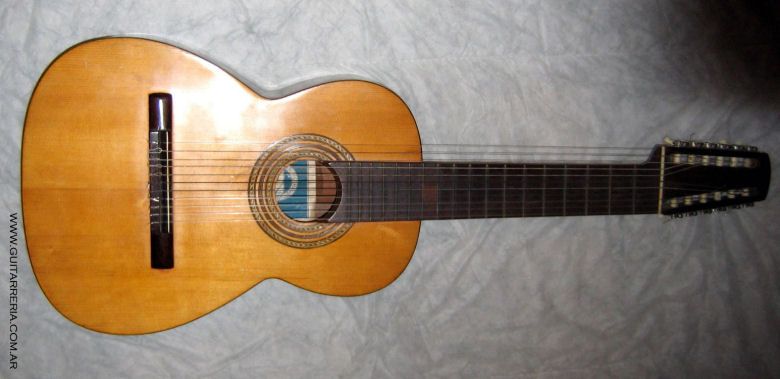
We've looked at many vintage guitars on this blog, but this one is positively antique. It is a 100-year old 11-string classical guitar by Breyer Hermanos, who - according to HarpGuitars.net - were a publisher of tango sheet music and also a music store in Buenos Aires. I wonder if they had their own luthier or if they simply applied their brand name to guitars from other manufacturers? I have no idea how this is tuned or how it should be played. Two of the five additional strings are over the fingerboard and so could be fretted but the other three are off the edge of the neck itself, so technically you could say that this was a harp guitar.

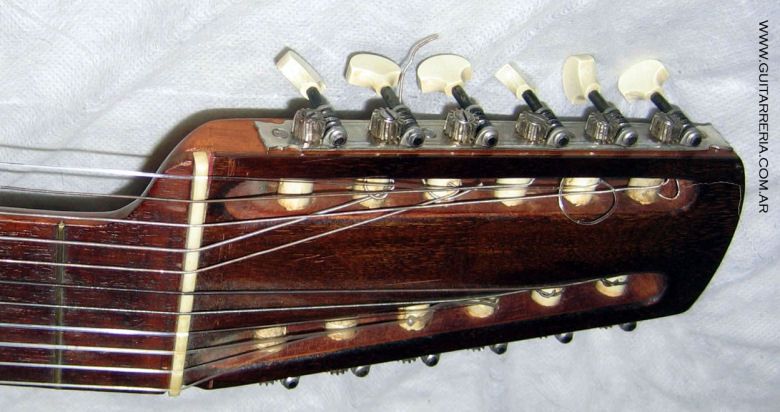
The additional strings seem to have been strung up to the machine heads in a rather bizarre order, as the photo below shows. Whether there is a good reason for this, I do not know. Note also that there are in fact 12 machine heads even though it is an 11-string instrument. The maker must have been striving for symmetry, despite the fact that the headstock already looks lop-sided against the neck with the three harp strings hanging off the edge.

G L Wilson

Guitarz - The Original Guitar Blog - now in its 9th year!

Tuesday, April 6, 2010

August Carlstedt Ideal Harp Guitar

guitarz.blogspot.com:

This harp guitar by August Carlstedt is not the kind of instrument that turns up very often on eBay. The seller has listed it as a "double neck" and I suppose that is not an innaccurate description of it, but you'll notice from the closeness of the upper neck carrying the sub-bass strings to the main neck that the sub-bass strings are not meant to be fingered (I won't say "fretted" for obvious reasons). The sub-basses are intended to be plucked as open strings - the neck is there merely to support these strings. The designs of harp guitar vary wildly; many other brands employed winged extensions to the body where this guitar has the extra neck. I assume that the fretless fingerboard on this example is there for aesthetic purpose only.

I note that currently the guitar has only two of its four sub-bass strings present. Possibly, in its current condition with cracked body top it would not be wise to string it up with the full complement of strings. I am curious as to the presence of four additional bridge pins on the treble-side of the guitar's bridge, which would suggest that the guitar may have had even more extra strings. However, there are no tuners present on the treble side of the body, nor marks to indicate where they may once have been. Could the four extra bridge pins be merely an aesthetic touch so as give provide visual balance to the whole bridge design?

August Carlstedt, by the way, lived from 1861 to 1928 and was a Swedish immigrant who ran a shop in Chicago during the early 20th century, building instruments under the Ideal brand.

This beautiful antique guitar is, as already mentioned, in need of some restoration. No doubt it will appeal to a collector of harp guitars; hopefully someone who will lavish some attention on it.

For more on harp guitars, see the excellent www.harpguitars.net website.

G L Wilson

Guitarz - The Original Guitar Blog - now in its 9th year!

Thursday, February 25, 2010

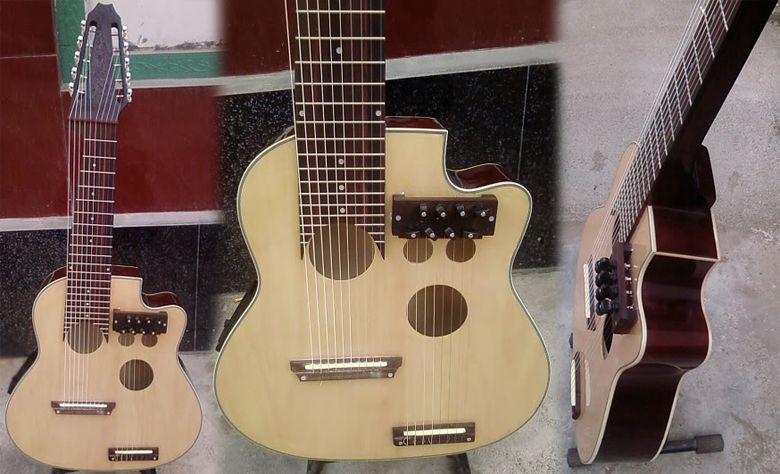
An incompetently-designed harp guitar (I think that's what it's supposed to be)

guitarz.blogspot.com:
Oh no, this is just dreadful. It's another one of those cheaply cobbled-together Chinese-made guitars that pay very little consideration to the playabilty or practicality of an instrument.

I'm not sure where to start... This appears to have extra strings just for the fun of it. Now, I know that some acoustics carrying additional strings will have "sub bass" strings that are positioned outside of the neck as they are intended to be played open, harp-style, but on this neck it looks like they couldn't decide if the bass strings should be over the fingerboard or not, so we've got a little bit of both on a very strangely shaped neck.

Speaking of neck shape, just look at the back of it. It must be square in cross-section. It doesn't look very playable.

I can't imagine how useful the other eight strings mounted on the body are. I guess you could have them tuned them to a chord. I'm also not convinced about the location of the tuners mounted in that little box on the front of the soundboard. Wouldn't it damp the vibrations of the top? Wouldn't it rattle?

But the thing that bugs me the most about this sorry effort of a guitar, is the cutaway on the body. The whole point of a cutaway on a guitar is to facilitate playing on the higher frets of the guitar at the body end of the fingerboard. But here, the cutaway is nowhere near the neck and therefore useless. What is the point? Not only is it without function, it also looks absolutely appalling.

I'm reminded of those dreadful Tennessee-brand guitars, and suspect that this guitar may originate from the same source.

G L Wilson

NB: Please make sure you are reading this Guitarz post at guitarz.blogspot.com and not on a Scraper blog that copies posts without permission (and steals bandwidth) so as to profit from advertising. Please support original bloggers!

Saturday, November 7, 2009

The Omstrument

guitarz.blogspot.com:

In our previous post about Uli Jon Roth's Sky Guitar, Bertram, my co-blogger here at Guitarz, made a note in the comments appealing for "Less frets, more strings!"

Is this enough strings for you, Bertram?

With a combined total of 46 strings, the Omstrument is the creation of Jack Haas and is a gestalt instrument comprising harp, guitar, longneck dulcimer, strumstick, and tanpura. And before you ask, yes, they are supposed to be played together at the same time.

Perhaps it's easier to let one of Mr Haas' videos do the talking:

Before anyone else comments, yes I am aware of Pat Metheny's 42-string Pikasso guitar created by luthier Linda Manzer. It's a crazy-looking guitar with strings all over the place, but surely more portable than the Omstrument!

G L Wilson

NB: There are a lot of blogs STEALING content and bandwidth. If you read this anywhere else but on guitarz.blogspot.com then you are reading a blog that STEALS content. Please support original bloggers!

Thursday, July 16, 2009

Some more scary "harp guitars" on eBay

Harp guitar banjo - wouldn't the 5th string tuner on the banbjo neck get in the way when playing the guitar neck?

The 18-string Thing - with 10-string nylon-strung neck, and inexplicably 8 additional steel treble strings on the body. The cutaway hardly looks very useful either.

The 15-string Electric Upright Harp Bass - I reckon they are making these things up as they go along. I don't think those treble strings would be very reachable when playing the bass in an upright position. I'm a little suspicious also of inlays in fretless fingerboards, which need to be as smooth as possible with no potential ridges or edges that the strings might catch on.

Wednesday, July 15, 2009

26-string Harp Guitar

There are some particularly wacko guitars on eBay right now, which is good news for this blog. This 26-string harp guitar is an acoustic with two six-string necks - one steel-strung, the other nylon, a set of six sub-bass strings and a set of eight treble strings. I understand the concept of sub-bass strings, but I'm not sure what you're supposed to do with the eight treble strings on the lower part of the body. Tune them to a chord perhaps?

The guitar is being sold by the ebay seller tropicalmoonmusic who have in the past sold some crazily-designed guitars from the Tennessee brand which have turned out to be very shoddily built and virtually unplayable. This harp guitar is very likely from the same source, even if it doesn't carry the Tennessee brand name. If you click through on the link and look at some of the other photos, it does look rather cheaply built. Look at the back of the two six string necks. They are virtually square.

It looks like fun, but I'd approach this guitar with caution.

Tuesday, January 27, 2009

Quick Quiz Answer: The Mystery Case

The Mystery Case

What lives in a case like this?

I think that most of you who commented were on the right lines when you answered "harp guitar", although I'm not sure if this Espana classical is technically a harp guitar as it doesn't have any extra strings.
Espana winged acoustic

I can only assume that the elongated body "wing" is there to give increased bass response.

However, it's not as wild as this example which we looked at on this blog last June. Can you imagine what the case would have looked like for that guitar?

Monday, June 23, 2008

Espana "Winged" Guitar

Espana SL-107 Winged guitarI've never seen anything quite like this Espana SL-107 winged guitar, although it is reminiscent of some of the wilder harp guitar designs without the additional strings.

It is quite a perplexing instrument. What, I wonder, was the point of those wings? Do they add anything to the tonality of the instrument?

Tuesday, June 17, 2008

Book Review: "GUITARS - A Celebration of Pure Mojo" by David Schiller

Guitars - A Celebration of Pure Mojo by David Schiller(Workman Publishing, ISBN 978-0-7611-3800-6)
Now I've noticed that a number of the other Guitar Blogs have been reviewing this small tome, but here is my take on it. I've not read any of the other reviews so as not to be influenced.

Anyway, let's begin. This small but perfectly formed book is laid out in a landscape orientation, and the dimensions are postcard size by approx 3 cm thick (520 pages), so it's pocket-sized so long as you have reasonably large pockets.

Now, this book works on a couple of levels. You can, as is the traditional way, start at the beginning and read right through to the end, or - if you are like me - you can dip in and out at various pages at random. The book is absolutely full of full colour pictures of guitars, all beautifully photographed, so it'll even appeal to the lazy amongst you who can't be bothered to read the text, but to do so would be doing the book a disservice as the text is well thought out and informative.

If you are a regular reader of my blog or one or more of the other guitar blogs listed on my blog-roll, then you will love this book as it essentially covers much of the same ground featuring classic guitars, vintage guitars, weird guitars, bizarre guitars, wonderful guitars, etc. Possibly the more rabid shredders may think there are too many acoustics featured, but to get it in perspective the acoustic guitar does have a lot more history than the electric. And anyway, it's all interesting stuff. You may not be into baroque, classical or jazz guitar, but it's all part of the bigger picture, so any prejudices need to be forgotten.

Without wanting to sound arrogant, I thought I was quite well up on all things guitar and had more or less seen it all, but there were plenty of instruments featured in here that were new to me such as the Vivi-Tone electric guitar from 1933, Gibson's sheet metal experimental electric guitar from 1935, the Gretsch Rumba round-bodied acoustic from 1933 (made to appeal to banjo players), among others.

There's plenty in here to fascinate: I particularly like the Stroh guitar with a megaphone horn in place of its body, and the various different styles of harp guitar which never fail to captivate my interest. Willie Nelson's legendary guitar "Trigger" is also a sight to behold!

My only gripe with the book is that some photos are printed over two facing pages - which may look great in the galleys when proofing the book in the production stages - but seeing as the finished book is perfect-bound and about an inch and a quarter thick, you cannot lay the pages flat to view these pictures properly. Not without destroying the book in the process. A whole area in the middle gets lost in the inner curvature of the pages. For example, what would have been a very attractive picture of a 1968 vintage paisley Fender Telecaster (pp. 344-345) is spoilt in this manner.

But that's a minor complaint. This is a perfect book for anyone who loves guitars. I can't praise it any more than that.
One other point, and this isn't a complaint, but merely an observation: there are no bass guitars featured. Could this mean another bass-specific volume will be forthcoming? (I hope so!)

On a final note, I must add that the book comes with the warning that the book may cause G.A.S. (Guitar Acquisition Syndrome). I think I was afflicted before anyway, so I can't blame David Schiller, or Workman Publishing of New York for that.