Bertram
Guitarz - The Original Guitar Blog - now in its 10th year!
guitar ,strings ,instrument ,guitar lessons ,electric guitar ,search ,pickups ,styles ,string ,scales ,lessons ,instruments ,how to ,guitars ,guitarra ,guitarists ,guitar tabs ,guitar tab ,fretboard ,united states ,the electric guitar ,the bridge ,reviews ,online dictionary ,headstock ,guitarist ,guitar tablature ,guitar pro ,guitar players ,guitar hero ,guitar gear ,
|
|
|
|
|---|
This strange-old 14-stringed instrument is currently up for sale on eBay, although I am not sure if the seller is correct in calling it a "guitar". The body shape is like that of a cittern. When the seller claims it is 24 inches long, I guess he is referring to the total length rather than the scale length, so to my mind that would make this instrument nearer in scale to a mandolin than a guitar because you have to factor in the length of that enormous headstock!
Having fourteen strings, you would be forgiven for thinking that it had seven courses of paired strings, but in fact it has only six courses, arranged with the highest three being tripled, the middle basses being doubled and the lowest bass being just a single string.
It's not a stringing system I have seen anywhere else, but perhaps it is better known than I believe. (I'm learning things all the time writing this blog). Possibly it is a relation of the Portuguese guitar, but with fourteen strings instead of twelve and a different headstock design. As usual, if anyone has any further info, please let us all know below in the comments.
G L Wilson
Additional: It's a Philippine Bandurria - see comments.
Guitarz - The Original Guitar Blog - now in its 9th year!
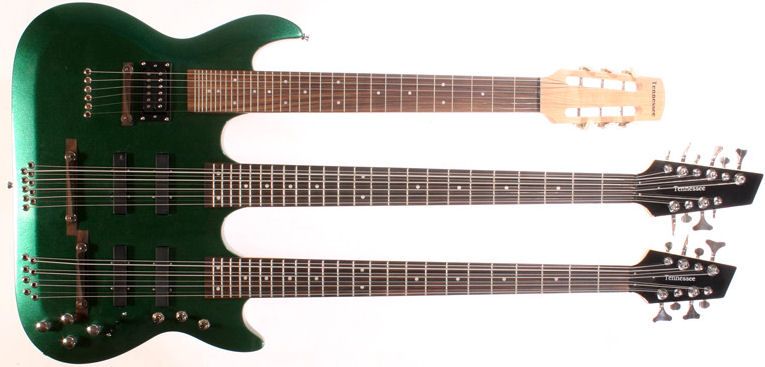
Uh-oh! You know you're in for trouble when you see a Tennessee-brand guitar. They are often very wacky instruments, but don't be fooled as the workmanship is shoddy and the instruments themselves are reported to be virtually unplayable.
But let's put aside the provenance for this discussion. Just look at this thing: it's a triple-neck comprising 8-string bass, 10-string bass, and 6-string lap steel.
Just WHY?
Why would anyone need that combination of necks on a single instrument? To start with, how many bass players double on "lap steel"? Not that this could ever be a real lap steel. Is the player supposed to un-strap it mid-song, sit down and lay the instrument on his lap for a lap steel solo?
Perhaps the "lap steel" neck was added because it was lying around at the factory at the time this ridiculous instrument was assembled.
Let's forget the lap steel neck. What about the two bass necks? Why would any bassist ever need a 8-string and a 10-string on one instrument? (That is to say, a 4-string and a 5-string with doubled courses, rather than 8 and 10 individual non-paired strings). Surely if you needed to play a song that required both 8-string and 10-string bass, all you'd need would be the 10-string neck and you could ignore the low B course in the sections that "require" the 8-string. In the same way, I can't see why anyone would ever need a 4-string and 5-string bass combination on the same instrument. I could understand a 4-string and 8-string, or a fretted and fretless, but this instrument shown above offers nothing of advantageous use.
It's utter nonsense, and as I've commented on previous occasions, Tennessee guitars seem to be put together by people who know nothing about guitars.
G L Wilson
NB: There are a lot of blogs STEALING content and bandwidth. If you read this anywhere else but on guitarz.blogspot.com then you are reading a blog that STEALS content. Please support original bloggers!
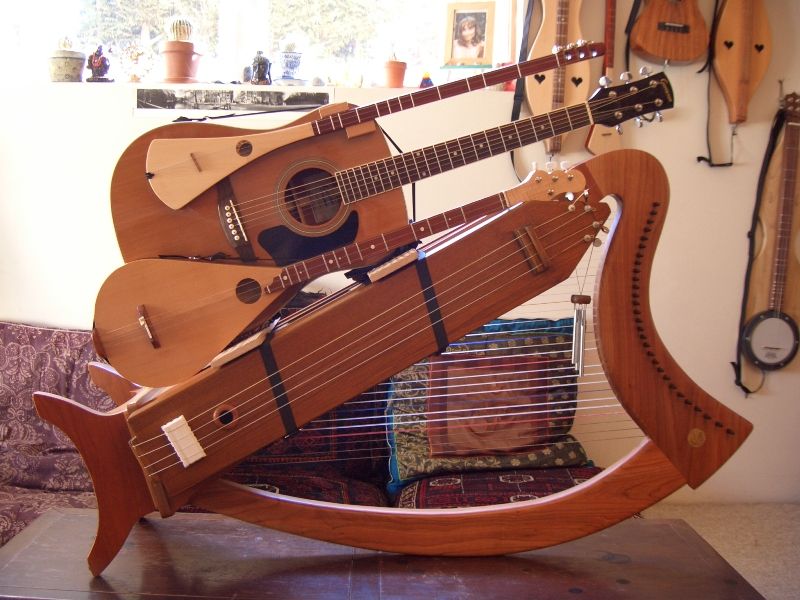
Is this enough strings for you, Bertram?
With a combined total of 46 strings, the Omstrument is the creation of Jack Haas and is a gestalt instrument comprising harp, guitar, longneck dulcimer, strumstick, and tanpura. And before you ask, yes, they are supposed to be played together at the same time.
Perhaps it's easier to let one of Mr Haas' videos do the talking:
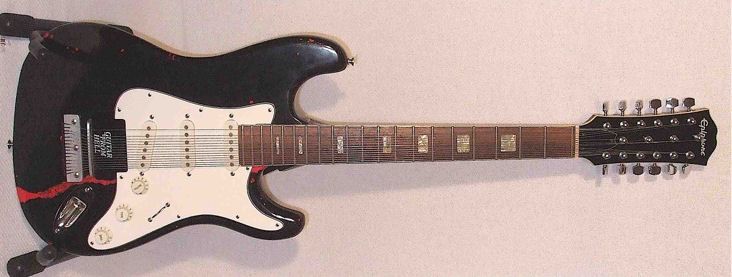
I'd like to thank Howard who forwarded this image of a 16-string guitar from Steve Albini's recording studio. It appears to be a "Frankenstein" creation with a hardtail Strat-like body (probably not a Fender) with a doctored Epiphone acoustic 12-string neck grafted onto it.
Note the four tuners in the center of the headstock (which must be bango style tuners with the buttons on the reverse) and also the simple bridge which has been moved further back than it would be on a Strat, a dictate of the neck used to allow for the correct scale and compensation.
It doesn't look like a very friendly-to-play instrument. I'm assuming that the strings are arranged in six courses as on a 12-string, but that the top four courses each have three strings. This means that the strings are all so close together that it is hard to tell where one course ends and the next begins. I'm guessing that the "Guitar from Hell" sticker near the bridge is appropriate!
G L Wilson
Additional (6 December 2009): Here's what Steve Albini himself says of the instrument:
It's a drone instrument. I saw a 12-string made like this (Epiphone neck on strat copy body) and asked the guy who made it how many strings he could fit on one guitar. His answer was 16, so I asked him to make one. The first one was a thank-you gift for Sonic Youth, who had invited Rapeman to play some shows with them in the UK. It turned out to be real fun to play, so I had another one made and that's the one we have here. It's used on a lot of records as a novelty, and on the Shellac song "Pull the Cup" in earnest.
The demo version of "Pull the Cup" is called "XVI," which is a hint.
Bob got to play one of Tom Petersson's 12-string basses at a Cheap Trick sound check, and I think he's going to see about getting one eventually. Expect everything to change once that happens.
http://www.electrical.com/phpBB3/viewtopic.php?f=4&t=46349&p=1007753
|
|
|---|